£3.99
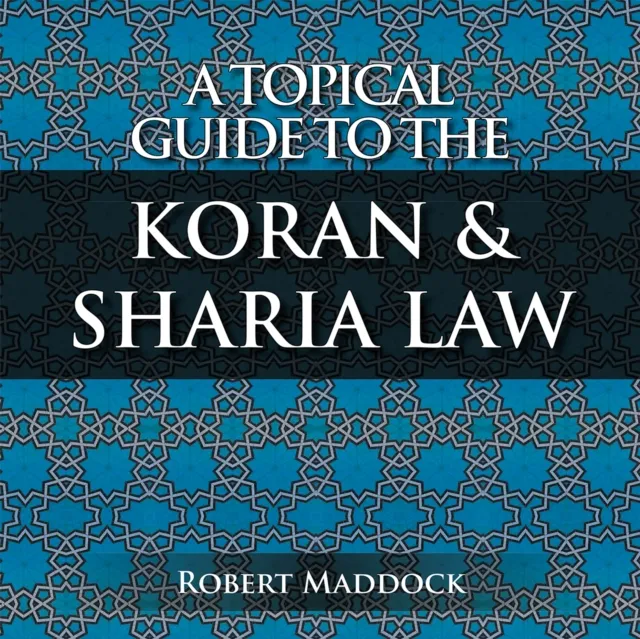
Topical Guide to the Koran & Sharia Law
Volume 1

Introduction
This book is based on the 1734 Translation of the Koran by George Sale. This translation is in King James English, making comparisons between it and the King James Bible easy. This is a topical guide that will take a word or short phrase and find it in every verse of the Koran where it appears. These verses are placed together so that the reader can readily determine the context and, therefore, the meaning of the word or phrase.
In some instances such as the word, jihad, which does not appear in the Sale translation, it is traced in the University of Michigan's online translation of the Koran. There it appears thirteen times, but in only two does it mean an internal struggle. In the other eleven, it means warfare.
Analysis of Words and Phrases
When analyzing words and phrases in the Koran, it is important to know when they were received and written. It is also important to know that the Koran includes material that seems to come from other sources. This has been outlined in Volume 2 of the 1300 Years' War.
Historical Context
As noted in Volume 1 of the 1300 Years War, Muhammad (PBUH) has been thought by many for over 150 years to have suffered from temporal lobe epilepsy associated with visual and auditory hallucinations. These seizures last less than three minutes. It is therefore important to know which suras might have come from a single episode. A table shows this in Volume 1 (table VIII).
Major Periods of the Koran
Many scholars divide the Koran into four major periods: Early Mecca (610–615 AD), Mid-Mecca (616 AD), Late Mecca (617–621 AD), and Medina (622–632 AD). The analysis of the verses in these periods found that militancy against non-Muslims progresses: 7.7 percent of the verses from Early Mecca are militant. This rises to 10.6 percent in the Mid-Mecca Period, and 18.3 percent in the Late Mecca Period. It tops out at 29.3 percent in the Medina Period.
Visual Representation of Periods
The colored version of the topical guide shows these periods in black, blue, green, and red. In the black and white edition, it shows these four periods of the Koran in plain italics, boldface italics, regular plain type, and boldface regular type.
Doctrine of Abrogation
The reason this division is important is the doctrine of abrogation (2:106) given early in the Medina period. This states that verses given later may nullify verses given earlier. Thus, many peaceful verses given in the early parts of the Koran may be nullified by the verse of the sword (9:5) given later toward the end of the Prophet's life: Slay the idolaters wherever you find them.
Conclusion
So far as I have been able to determine, there has been no stylistic analysis of the Koran. A person studying the Koran or the history of Islam will find this work most valuable.