£101.00
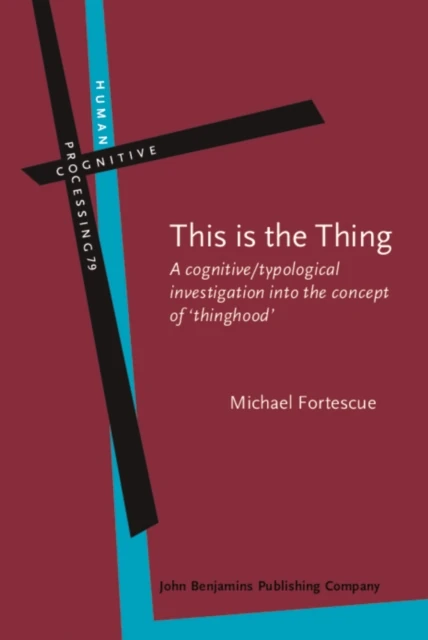
This is the Thing
A cognitive/typological investigation into the concept of 'thinghood'

Introduction
This monograph investigates for the first time words like 'thing' of maximal semantic generality across languages. Not all languages have exact equivalents of English 'thing' - in some, for instance, the nearest equivalent is an interrogative stem ('what?'). Few languages extend their 'thing' words into indefinite 'something', 'anything', 'nothing', as in English.
As regards Indo-European languages, Buck (1988) points out that such words typically derive from a more abstract source than that of simple material objects. In the case of 'thing', the earliest source usually given is the Germanic word for a 'judicial assembly'.
Development and Questions
How does such a word develop the most general sense of 'thing' today? Do all languages follow this kind of pattern? These questions lead into an investigation of the concept of 'thing' in a wide range of contexts and in a wide variety of languages, involving both typological and cognitive aspects. The results have sometimes been unexpected.
Reference
Buck, C. D. 1988. A Dictionary of Selected Synonyms in the Principal Indo-European Languages. Chicago: The University of Chicago Press.