£19.99
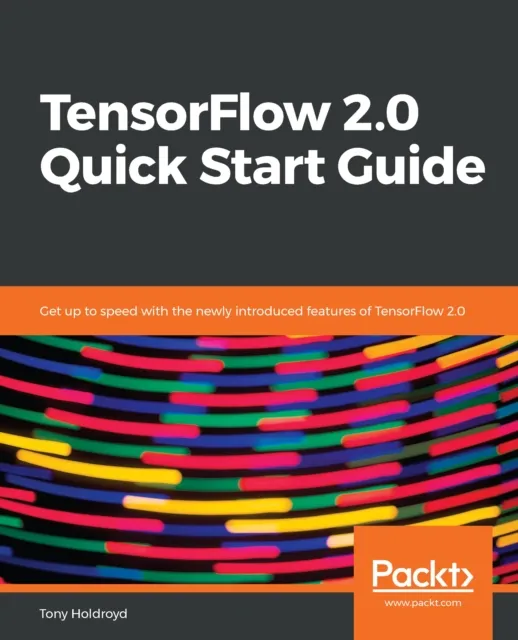
TensorFlow 2.0 Quick Start Guide
Get up to speed with the newly introduced features of TensorFlow 2.0

Perform supervised and unsupervised machine learning and learn advanced techniques such as training neural networks.
Key Features
Train your own models for effective prediction, using high-level Keras API
Perform supervised and unsupervised machine learning and learn advanced techniques such as training neural networks
Get acquainted with some new practices introduced in TensorFlow 2.0 Alpha
Book Description
TensorFlow is one of the most popular machine learning frameworks in Python. With this book, you will improve your knowledge of some of the latest TensorFlow features and will be able to perform supervised and unsupervised machine learning and also train neural networks.
After giving you an overview of what’s new in TensorFlow 2.0 Alpha, the book moves on to setting up your machine learning environment using the TensorFlow library. You will perform popular supervised machine learning tasks using techniques such as linear regression, logistic regression, and clustering.
You will get familiar with unsupervised learning for autoencoder applications. The book will also show you how to train effective neural networks using straightforward examples in a variety of different domains.
By the end of the book, you will have been exposed to a large variety of machine learning and neural network TensorFlow techniques.
What you will learn
Use tf.Keras for fast prototyping, building, and training deep learning neural network models
Easily convert your TensorFlow 1.12 applications to TensorFlow 2.0-compatible files
Use TensorFlow to tackle traditional supervised and unsupervised machine learning applications
Understand image recognition techniques using TensorFlow
Perform neural style transfer for image hybridization using a neural network
Code a recurrent neural network in TensorFlow to perform text-style generation
Who this book is for
Data scientists, machine learning developers, and deep learning enthusiasts looking to quickly get started with TensorFlow 2 will find this book useful. Some Python programming experience with version 3.6 or later, along with a familiarity with Jupyter notebooks will be an added advantage. Exposure to machine learning and neural network techniques would also be helpful.