£59.99
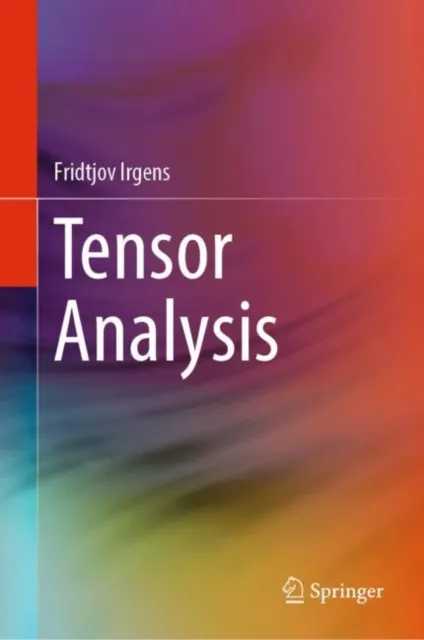
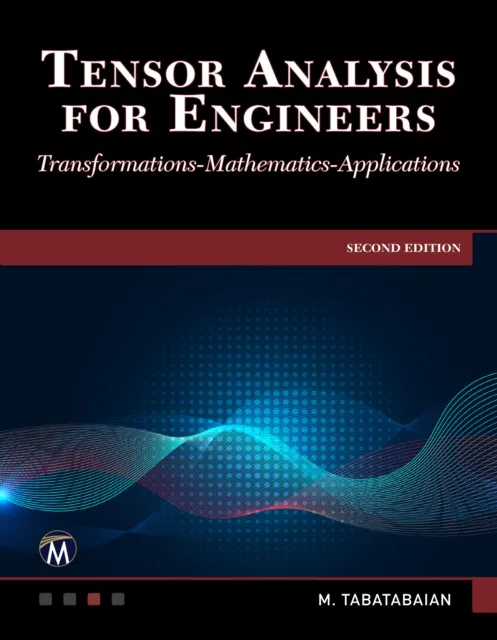
Tensor Analysis for Engineers
Mastering Coordinate Systems, Transformations and Applications using Mathematics

A comprehensive guide to tensor analysis in engineering, covering transformations, mathematical foundations, and practical applications.
Key Features
Covers foundational and advanced concepts in tensor analysis
Focuses on practical engineering applications and problem-solving
Includes numerous examples and exercises to reinforce learning
Book Description
This book is a comprehensive guide to tensor analysis for engineers and applied scientists, focusing on practical problem-solving in Euclidean space. It covers Cartesian coordinate systems and curvilinear coordinates like cylindrical and spherical, with examples and calculations. Expanded content includes rigid body rotation, Cartesian tensors, Euler angles, and quaternion methods. The course begins with coordinate systems, moving through curvilinear systems, basis vectors, and scale factors. It covers contravariant and physical components, tensor transformations, and mixed and metric tensors. Advanced topics include gradient operators, derivative forms, Cartesian tensor transformations, and coordinate-independent equations. The book features relations for selected coordinate systems, rigid body rotation methods, and numerous worked-out examples and exercises. Mastering tensor analysis is crucial for complex engineering and science problems. This book transitions from basic concepts to advanced applications, blending theory with practical examples. Clear explanations, figures, and exercises enhance learning, making this an essential resource for tensor analysis in Euclidean space.
What you will learn
Understand index notation and the Einstein summation convention
Learn to define and transform coordinate systems
Calculate dot and cross products of tensors
Apply metric tensor operations
Compute covariant and contravariant derivatives
Solve practical engineering problems using tensor analysis
Who this book is for
Ideal for engineering students, professionals, and researchers who want to understand and apply tensor analysis in their work. Readers should have a basic understanding of linear algebra and calculus. No prior knowledge of tensor analysis is required.