£24.79
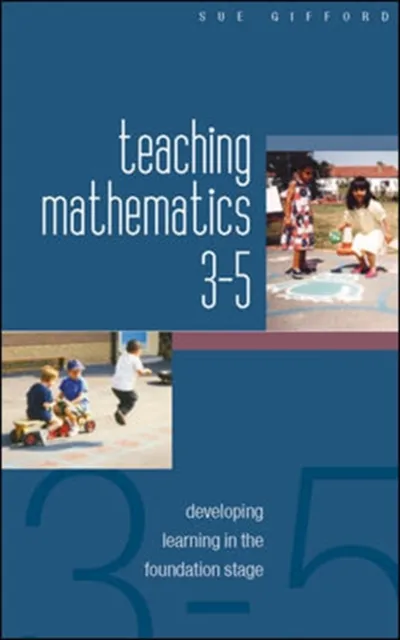
Teaching Mathematics 3-5

Review
"With freshness, humour and originality, Sue Gifford demonstrates the interactive strategies that are required to teach mathematics to young children. The text is both refreshingly free from conventional wisdom and solidly grounded in recent research on learning and teaching early mathematics. At the same time, it is unfailing in its accuracy in uncovering children''s own humour and instinct for subverting ''teacherly'' overtures. Given the demonstrated lack of spontaneous mathematics in early childhood setting, this assembled collage of children''s own observations, activities and comments is in itself a work of art." Professor Carol Aubrey, Institute of Education, University of Warwick, UK.
Key Questions
- What are the most important aspects of mathematics for young children to learn?
- How do children learn mathematics?
- How can adults best ‘teach’ mathematics to children so young?
The book informs practitioners, students and parents about how three– to five-year-olds learn mathematics, and shows them how best to develop enjoyable mathematical learning in early years settings. The book includes a summary of relevant research and considers issues relating to current practice. This book:
- Establishes principles for teaching mathematics to young children
- Takes into account the way children learn, including social, emotional, physical and cognitive aspects
- Helps practitioners find the middle ground between not initiating enough mathematical activity and being too directive
- Suggests principles and frameworks for planning and assessment.
The book places particular emphasis on adult-initiated, number-focused activities and playful, challenging and sensitive teaching strategies to engage younger children. The strategies are based on research and work with practitioners, and are illustrated by children’s own responses, such as making number jokes. It covers key areas of mathematics, including number, shape and space, measures and problem solving, with appropriate expectations and common difficulties as well as suggested activities.
Essential reading for those teaching or preparing to teach mathematics to young children, as well as parents interested in the mathematical education of their children.