£89.50
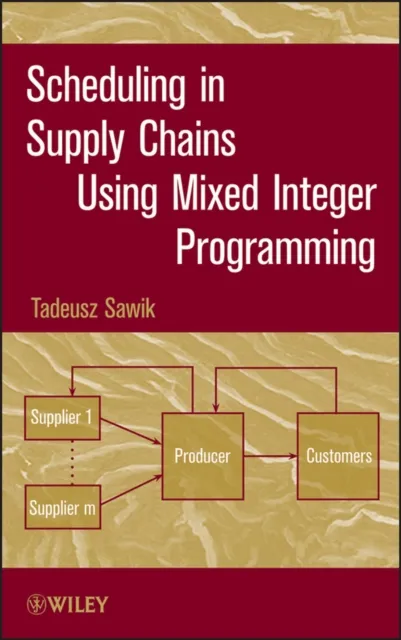
Supply Chain Disruption Management Using Stochastic Mixed Integer Programming

Book Overview
This book deals with stochastic combinatorial optimization problems in supply chain disruption management, with a particular focus on management of disrupted flows in customer-driven supply chains. The problems are modeled using a scenario based stochastic mixed integer programming to address risk-neutral, risk-averse and mean-risk decision-making in the presence of supply chain disruption risks. The book focuses on innovative, computationally efficient portfolio approaches to supply chain disruption management, e.g., selection of primary and recovery supply portfolios, demand portfolios, capacity portfolios, etc.
Computational Examples and Tools
Numerous computational examples throughout the book, modeled in part on real-world supply chain disruption management problems, illustrate the material presented and provide managerial insights. In the computational examples, the proposed mathematical programming models are solved using an advanced algebraic modeling language such as AMPL and CPLEX, GUROBI and XPRESS solvers. The knowledge and tools provided in the book allow the reader to model and solve supply chain disruption management problems using commercially available software for mixed integer programming. Using the end-of chapter problems and exercises, the monograph can also be used as a textbook for an advanced course in supply chain risk management.
Book Structure
After an introductory chapter, the book is then divided into five main parts. Part I addresses selection of a supply portfolio; Part II considers integrated selection of supply portfolio and scheduling; Part III looks at integrated, equitably efficient selection of supply portfolio and scheduling; Part IV examines integrated selection of primary and recovery supply (and demand) portfolios and scheduling; and Part V addresses disruption management of information flows in supply chains.