£89.50
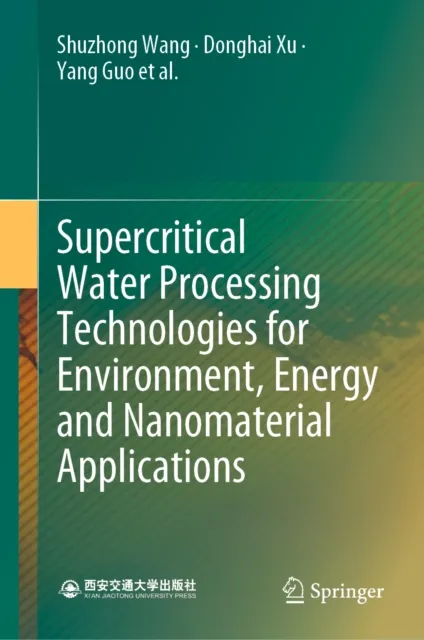
Supercritical Water Processing Technologies for Environment, Energy and Nanomaterial Applications

Introduction to Supercritical Water Technologies
This book systematically presents the technical aspects of supercritical water oxidation and supercritical water gasification for energy and environmental applications, which include reactor design, construction materials, corrosion, salt precipitation, etc. The book provides a comprehensive introduction to the properties of supercritical water, and the industrial applications, reaction mechanisms and reaction kinetics of supercritical water oxidation (SCWO) and supercritical water gasification (SCWG).
Reaction Mechanisms and Challenges
The reactions occurring in supercritical water are complex, and studying their reaction mechanisms is of great importance for the development of supercritical water processing technologies. Accordingly, the book explains the oxidative mechanisms and kinetics of organic matter in supercritical water in detail. However, the harsh reaction conditions in supercritical water can easily create severe reactor corrosion and salt deposition problems. Therefore, the book also comprehensively reports on the mechanism analysis, state of research, and development trends regarding these two problems.
Technological Developments and Applications
Lastly, the book summarizes the development of supercritical water processing technologies, including studies on SCWO and SCWG, as well as near-zero-emission systems of pollutants based on SCWO technology. In short, the book provides a wealth of valuable information for all readers who are interested in using SCWO for organic waste treatment, and in using SCWG for hydrogen production with wet biomass.