£109.50
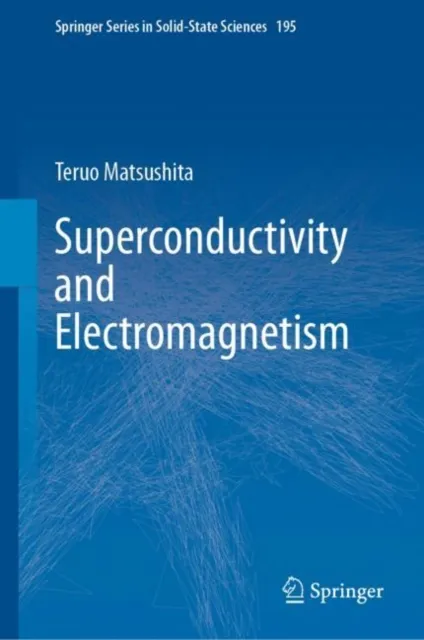
Superconductivity and Electromagnetism

Introduction to Electromagnetic Phenomena in Superconductivity
This book introduces readers to the characteristic features of electromagnetic phenomena in superconductivity. It first demonstrates not only that the diamagnetism in the superconductivity complies with Maxwell’s theory, which was formulated before the discovery of superconductivity, but also that the dominant E-B analogy in the electromagnetism loses perfection without the superconductivity.
The book then explores flux pinning, which is responsible for the non-dissipative current in DC, leading to irreversibility in AC. Drawing on Maxwell’s work, it also proves theoretically that if there is no energy dissipation in the superconductivity caused by the break in time reversal symmetry, it contradicts the thermodynamic principle of energy conservation – something that had previously only been proved experimentally.
Longitudinal Magnetic Field Effect
Lastly, the book addresses the longitudinal magnetic field effect, and explains how this phenomenon leads to a new development of Maxwell’s theory.
Additional Features
Featuring numerous appendices to help readers understand the methods of derivation of equations, this book offers students and young scientists an introduction to applied superconductivity, especially in the context of power applications.
Target Audience
Presenting the characteristic features of electromagnetic phenomena in superconductivity from basic to advanced topics for applications, the book offers a valuable resource for graduate students and researchers studying superconductivity as well as engineers working in electric utility industry.