£109.50
£109.99
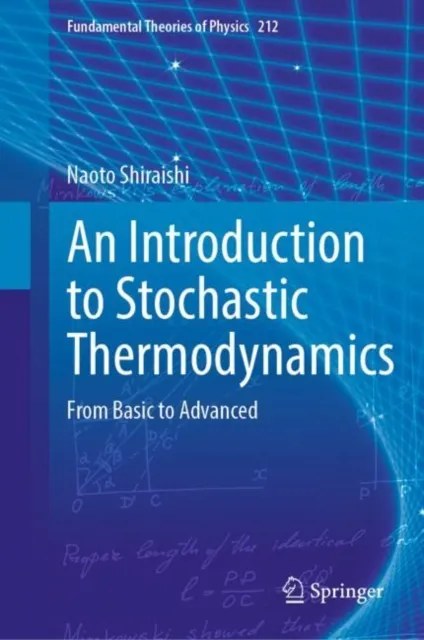
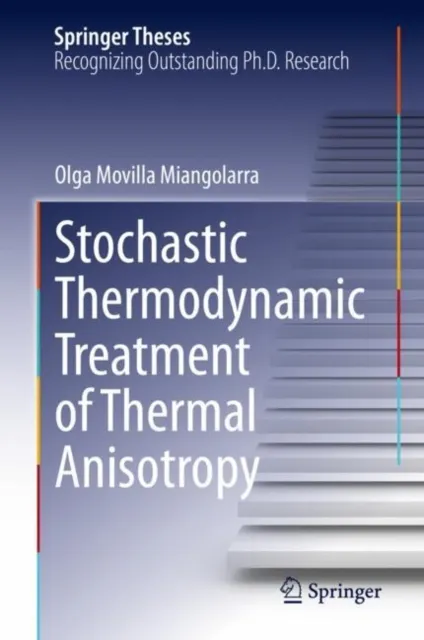
Stochastic Thermodynamic Treatment of Thermal Anisotropy

Introduction
This thesis advances our understanding of how thermal anisotropy can be exploited to extract work through a mechanism that is quite distinct from the classical Carnot heat engine. Anisotropy, the presence of thermal or chemical gradients, is ubiquitous in the real world and powers the cascade of processes that sustain life.
Quantification of Power and Efficiency
The thesis quantifies, for the first time, the maximum amount of power and efficiency that a suitable mechanism (a Brownian gyrator) can achieve in such conditions. An important contribution at the center of the thesis is to lay out a geometric framework that brings out the importance of an isoperimetric problem to analyze and quantify optimal operation of thermodynamic engines that harvest energy when simultaneously in contact with several heat baths.
Geometric Framework and Theoretical Foundations
Fundamental bounds are derived via isoperimetric inequalities which capture the trade-off between work and dissipation that accrue during thermodynamic cycles. A geometric theory that allows such insights is explained first – the theory of optimal mass transport – followed by rudiments of stochastic thermodynamics that allow for quantification of work and entropy production during finite-time thermodynamic transitions.
Entropy Production and Autonomous Engine
The thesis further explores entropy production due to heat flowing between heat baths of different temperature through the system dynamics, and concludes with analysis as a proof-of-concept of an autonomous engine that harvests energy from a thermal gradient to continuously produce work in a stable limit cycle operation.