£38.00
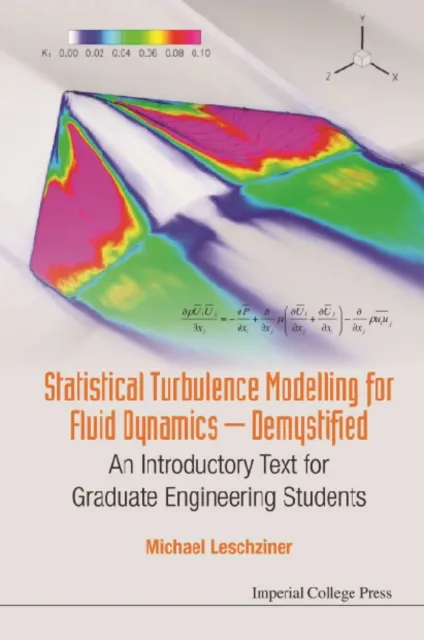
Statistical Turbulence Modelling For Fluid Dynamics - Demystified: An Introductory Text For Graduate Engineering Students

Introduction
This book is intended for self-study or as a companion of lectures delivered to post-graduate students on the subject of the computational prediction of complex turbulent flows.
There are several books in the extensive literature on turbulence that deal, in statistical terms, with the phenomenon itself, as well its many manifestations in the context of fluid dynamics.
Focus and Approach
Statistical Turbulence Modelling for Fluid Dynamics — Demystified differs from these and focuses on the physical interpretation of a broad range of mathematical models used to represent the time-averaged effects of turbulence in computational prediction schemes for fluid flow and related transport processes in engineering and the natural environment.
It dispenses with complex mathematical manipulations and instead gives physical and phenomenological explanations.
Educational Benefits
This approach allows students to gain a 'feel' for the physical fabric represented by the mathematical structure that describes the effects of turbulence and the models embedded in most of the software currently used in practical fluid-flow predictions, thus counteracting the ill-informed black-box approach to turbulence modelling.
This is done by taking readers through the physical arguments underpinning exact concepts, the rationale of approximations of processes that cannot be retained in their exact form, and essential calibration steps to which the resulting models are subjected by reference to theoretically established behaviour of, and experimental data for, key canonical flows.