£44.99
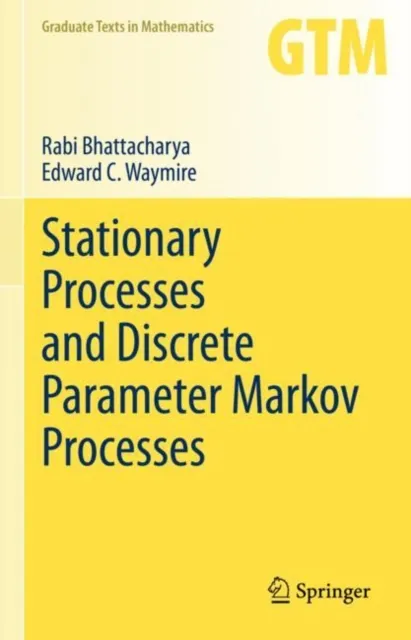
Stationary Processes and Discrete Parameter Markov Processes

This textbook explores two distinct stochastic processes that evolve at random: weakly stationary processes and discrete parameter Markov processes. Building from simple examples, the authors focus on developing context and intuition before formalizing the theory of each topic. This inviting approach illuminates the key ideas and computations in the proofs, forming an ideal basis for further study.
After recapping the essentials from Fourier analysis, the book begins with an introduction to the spectral representation of a stationary process. Topics in ergodic theory follow, including Birkhoff’s Ergodic Theorem and an introduction to dynamical systems. From here, the Markov property is assumed and the theory of discrete parameter Markov processes is explored on a general state space. Chapters cover a variety of topics, including birth–death chains, hitting probabilities and absorption, the representation of Markov processes as iterates of random maps, and large deviation theory for Markov processes. A chapter on geometric rates of convergence to equilibrium includes a splitting condition that captures the recurrence structure of certain iterated maps in a novel way. A selection of special topics concludes the book, including applications of large deviation theory, the FKG inequalities, coupling methods, and the Kalman filter.
Featuring many short chapters and a modular design, this textbook offers an in-depth study of stationary and discrete-time Markov processes. Students and instructors alike will appreciate the accessible, example-driven approach and engaging exercises throughout. A single, graduate-level course in probability is assumed.