£45.99
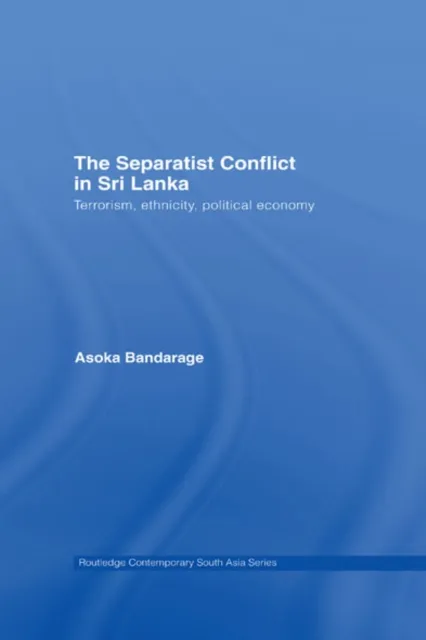
Separatist Conflict in Sri Lanka
Terrorism, ethnicity, political economy

Book Overview
The book provides a detailed historically-based analysis of the origin, evolution and potential resolution of the civil conflict in Sri Lanka over the struggle to establish a separate state in its Northern and Eastern provinces. This conflict between the Sri Lankan government and the secessionist LTTE (Liberation Tigers of Tamil Eelam) is one of the world’s most intractable contemporary armed struggles. The internationally banned LTTE is considered the prototype of modern terrorism. It is known to have introduced suicide bombing to the world, and recently became the first terrorist organization ever to acquire an air force.
The Ethnicity and Conflict
The ‘iron law of ethnicity’ – the assumption that cultural difference inevitably leads to conflict – has been reinforced by the 9/11 attacks and conflicts like the one in Sri Lanka. However, the connections among ethnic difference, conflict, and terrorism are not automatic. This book broadens the discourse on the separatist conflict in Sri Lanka by moving beyond the familiar bipolar Sinhala versus Tamil ethnic antagonism to show how the form and content of ethnicity are shaped by historical social forces. It develops a multipolar analysis which takes into account diverse ethnic groups, intra-ethnic, social class, caste and other variables at the local, regional and international levels. Overall, this book presents a conceptual framework useful for comparative global conflict analysis and resolution, shedding light on a host of complex issues such as terrorism, civil society, diasporas, international intervention and secessionism.