£23.99
£41.99
Self-Different Fractals and Innovation
Academic Firm and the Entrepreneurial University in Epistemic Governance

The Concept of Self-Different Fractals
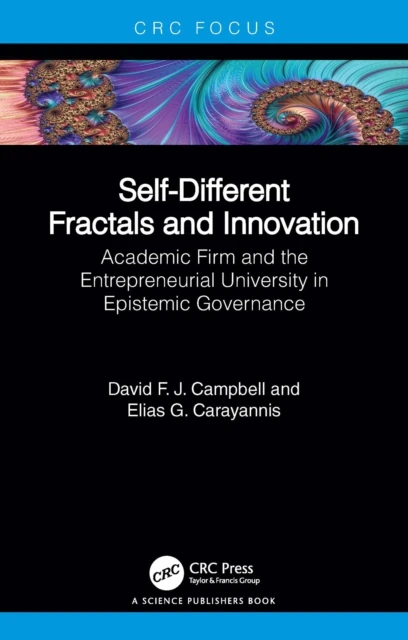
The presented ideas create and shape the vision of a "Manifesto of Higher Education Governance". Fractals are typically understood as self-similar structures, but this concept is expanded to include "self-different fractals". These fractals align with a "Philosophy of Dialectics", where opposing forces (thesis and antithesis) can either create disruption or, when managed effectively, drive creativity, innovation, and development. Because self-different fractal systems operate in multiple modes, they hold greater potential for fostering innovation.
Dialectical Approaches to Innovation
This conceptual exploration investigates innovation in higher education through dialectical approaches, presenting the entrepreneurial university as a thesis, the academic firm as an antithesis, and epistemic governance as a synthesis. Epistemic governance plays a key role in motivating innovation by integrating pluralistic knowledge and innovation modes.
Self-Different Fractal Innovation Systems
The concept of "self-different fractal innovation systems"—structures that embody multiple, interacting modalities—enhances innovation potential through their fluid complexity. Good and effective governance of these systems encourages continual knowledge evolution, enabling the development of "next-knowledge". This process, guided by the dialectics of innovation, forms new, integrated structures and networks.
Interdisciplinary and Transdisciplinary Approaches
The book emphasizes interdisciplinary and transdisciplinary approaches, with the latter involving collaboration between scholars and user communities for real-world impact. It bridges science and art, suggesting that visual representations of self-different fractals inspire artistic research alongside scientific inquiry.
Systems and Societal Progress
Through examining both linear and non-linear systems, the authors reveal how conflicting principles can generate productive chaos, ultimately driving innovation, societal progress, and knowledge democracy. The future of governance is also the future of higher education.