£139.99
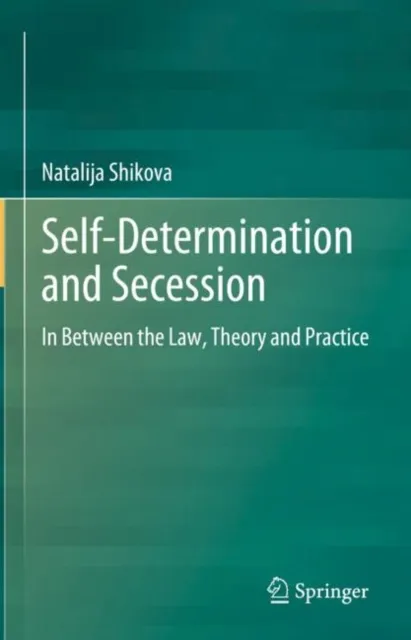
Self-Determination and Secession
In Between the Law, Theory and Practice

Summary of International Law on Self-Determination and Secession
This book offers a comprehensive summary of extant international law scholarship on the topics of self-determination and secession and positions the concepts among present-day theory and relevant practice, illustrated through various ongoing cases and historical examples. The right to self-determination is among the least understood rights within international law. Theoretical dilemmas – as to whether there is a link between self-determination and secession – are nothing new. In essence, self-determination is a much broader concept than secession and obtaining independent statehood. Unilateral secession is not prohibited by international law, but neither is it per se welcomed or accepted in practice. Beyond the context of decolonization, secession claims have long been viewed with disapproval in international law, and lawyers have been extremely skeptical about the issue. Although this is still the case, there are also new trends and opportunities to explore situations in which secession can be accepted, legitimized, or even legally permissible. The yardstick for this is the diplomatic response to secessionism and the growing involvement of the international community in mediation and conflict resolution. Though finding solutions can be difficult, within the existing frame, the ongoing tension between the duty of every society to recognize pluralism and diversity on the one hand, and the inherent desire of every culture – whether majority, minority or indigenous – to protect its values and ensure conformity on the other, must be resolved. The practices and modalities that envisage the internal dimension of the right to self-determination as a right that is exercised within the state borders can offer such opportunities. The appropriate role of the state and the international community is to serve as mediators between competing forces and to set parameters that can transform destructive conflicts into productive political models.