£8.99
Science Facts in Bible Wisdom
Evidence Against Moral Relativity

Unlike most books attempting to reconcile the facts of science with the wisdom of the Holy Bible
Harry W. Miller's book, Science Facts in Bible Wisdom, does not waste the reader's time with long, convoluted arguments. Instead, it cuts right through to the substantive evidence to show that today's science is discovering increasingly the very truths that the Bible's wisdom has always contained, citing scientists and the Bible. The bottom line truth concerning reality, both for science and the Bible, is that it is not relative or divisive in nature; it is instead relational and unifying. Jesus Christ being the keystone evidence of that fact by the complementary, holistic nature of his mortal human yet divine person. Thus, the Bible tells us, since the creation of the world his [God's] invisible nature, namely his eternal power and deity, has been clearly perceived in the things that have been made [most particularly in the person of Jesus Christ, born of woman] (Romans 1:20).
Science Facts in Bible Wisdom is in three parts. The first two focus on sciences and the Bible's correlative information concerning the creation of the universe, the human person, and the emergence of the subjective consciousness with its two tracks of awareness. The third part focuses upon the more intimate aspects of personal or experiential knowledge such as prayer, miracles, and visions (including two of the authors' own), as well as the documentation of near-death and out-of-body experiences by scientists of the International Association of Near-Death Studies (IANDS).
Within the heart of each human being
there resides a deep-seated, spiritual desire to know in both an intimate and substantive fashion that ultimate source of their existence, most often referred to as God. Humanity is forever reaching out to that ultimate source, very much as Adam is in Michelangelo's classic Sistine Chapel painting, The Creation of Adam.
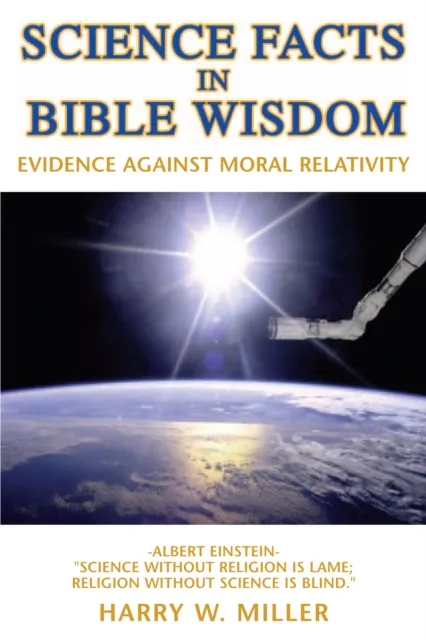
The NASA photo on the cover of Science Facts in Bible Wisdom
like Michelangelo's famous painting, is evidence that even with today's secular culture, humanity continues to pursue its innate, even if often subconscious, spiritual imperative to know its Creator, not just spiritually but in truth. Today, however, the search for credible, substantive evidence and that transcendental truth, God, for which it speaks, comes evermore frequently by way of the amazing, new empirical findings of science. Thus, on this book's cover, in place of Adam's arm reaching out to God, we see instead the space shuttle's robot arm reaching out to the visible evidence of God's invisible nature... the things that have been made (Rom. 1:20).
The importance of evidence and reason
As this book attempts to show, the truth of any kind must always rest upon relevant evidence. But it cannot rest upon self-righteous ideologies nor the blind beliefs of the large assortment of locally popular human traditions (habits). Evidence and reason are always necessary, whether the evidence required and the truth being pursued are of a more visible, tangible kind, as at a crime scene, or if they are of a less visible or ethereal nature. In the latter case, the truth and that evidence which speaks for it must necessarily be articulated by means of an indirect, analogical, or symbolic form of language. The only language which can, in effect, make known more clearly the particular nature of such mysterious, invisible truths by making them more concrete to the limited cognitive scope of the human mind.
The language of science and religion
Such a language must be used by both science and religion. The symbolic form of language favored by science is one comprised of mathematical symbols. On the other hand, the language favored by religion, such as that used in the Holy Bible, must often take on a metaphorical or figurative form in order to make those spiritual things that cannot now be seen more concrete to the human understanding.