£44.99
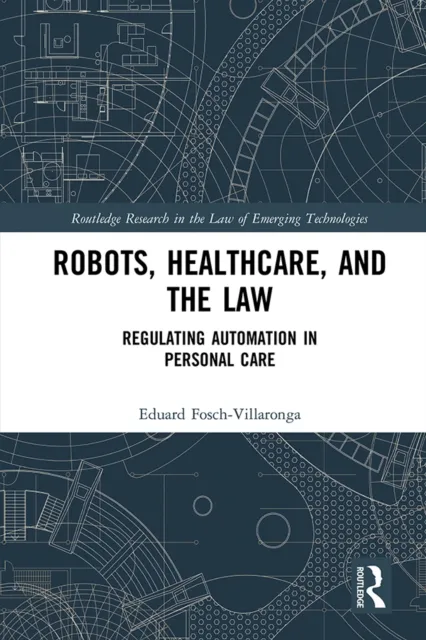
Robots, Healthcare, and the Law
Regulating Automation in Personal Care

Introduction
The integration of robotic systems and artificial intelligence into healthcare settings is accelerating. As these technological developments interact socially with children, the elderly, or the disabled, they may raise concerns besides mere physical safety; concerns that include data protection, inappropriate use of emotions, invasion of privacy, autonomy suppression, decrease in human interaction, and cognitive safety. Given the novelty of these technologies and the uncertainties surrounding the impact of care automation, it is unclear how the law should respond.
Scope of the Book
This book investigates the legal and regulatory implications of the growing use of personal care robots for healthcare purposes. It explores the interplay between various aspects of the law, including safety, data protection, responsibility, transparency, autonomy, and dignity; and it examines different robotic and AI systems, such as social therapy robots, physical assistant robots for rehabilitation, and wheeled passenger carriers. Highlighting specific problems and challenges in regulating complex cyber-physical systems in concrete healthcare applications, it critically assesses the adequacy of current industry standards and emerging regulatory initiatives for robots and AI. After analyzing the potential legal and ethical issues associated with personal care robots, it concludes that the primarily principle-based approach of recent law and robotics studies is too abstract to be as effective as required by the personal care context. Instead, it recommends bridging the gap between general legal principles and their applicability in concrete robotic and AI technologies with a risk-based approach using impact assessments.
Significance
As the first book to compile both legal and regulatory aspects of personal care robots, this book will be a valuable addition to the literature on robotics, artificial intelligence, human–robot interaction, law, and philosophy of technology.