£45.99
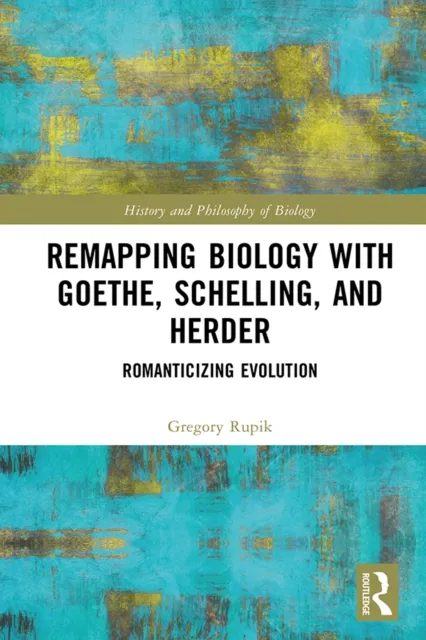
Remapping Biology with Goethe, Schelling, and Herder
Romanticizing Evolution

Remapping Biology with Goethe, Schelling, and Herder
Remapping Biology with Goethe, Schelling, and Herder recruits a Romantic philosophy of biology into contemporary debates to both integrate the theoretical implications of ecology, evolution, and development, and to contextualize the successes of the Modern Evolutionary Synthesis’s gene’s-eye-view of biology.
The dominant philosophy of biology in the twentieth century was one developed within and for the Modern Evolutionary Synthesis. As biologists like those developing an Extended Evolutionary Synthesis have pushed the limits of this paradigm, fresh philosophical approaches have become necessary. This book makes the case that an organicism developed by the 19th century figures Goethe, Schelling, and Herder offers surprising resources to navigate the contemporary biological and evolutionary terrain. This “metamorphic organicism” resonates with present trends in biological theory that emphasize process, organismal dynamics, ecology, and agency. It also proposes strategies for reintegrating reductive and mechanistic maps of biology, like those of the Modern Evolutionary Synthesis, into richer theoretical representations of life.
Drawing from cutting-edge biology, Romantic history, and perspectival pluralist literatures, this integrated history-and-philosophy-of-biology will be of interest to students and scholars interested in the genesis of current theoretical tensions in evolutionary biology, and to those seeking constructive ways to resolve those tensions, including practicing biologists and educators.