£7.99
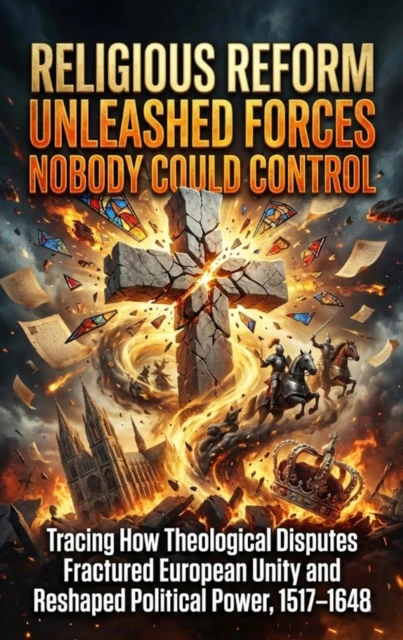
Religious Reform Unleashed Forces Nobody Could Control
Tracing How Theological Disputes Fractured European Unity and Reshaped Political Power, 1517-1648

Introduction
Martin Luther's 95 Theses sparked debates he never intended to become revolutionary, yet within decades Europe descended into religious wars that killed millions and permanently shattered Christian unity. This book examines how theological disagreements about salvation, scripture, and Church authority escalated into political upheaval that transformed governance, social structures, and individual conscience across the continent.
Through Reformation pamphlets, council proceedings, personal correspondence, princely decrees, and eyewitness accounts of violence, the narrative traces how reform movements multiplied beyond anyone's control. Luther wanted Church purification; radical reformers rejected all institutional religion. Princes saw opportunities to seize Church lands and assert independence from Rome. Peasants interpreted “Christian freedom” as liberation from serfdom. Catholic authorities responded with both Counter-Reformation renewal and brutal suppression.
Consequences and Regional Impact
The book follows these cascading consequences across social classes and regions: how printing technology spread ideas faster than authorities could contain them, how religious identity became intertwined with emerging national consciousness, how theological concepts about individual relationship with God undermined hierarchical social orders. It examines the Peace of Augsburg's attempt at religious coexistence, its failure, and the Thirty Years' War that devastated Central Europe before exhaustion forced compromise.
Overlooked Dimensions
The narrative explores often-overlooked dimensions: women's roles in reform movements despite exclusion from formal authority, Jewish communities caught between competing Christian powers, and how religious division paradoxically enabled modern concepts of tolerance and secular governance when neither side could achieve total victory.