£74.50
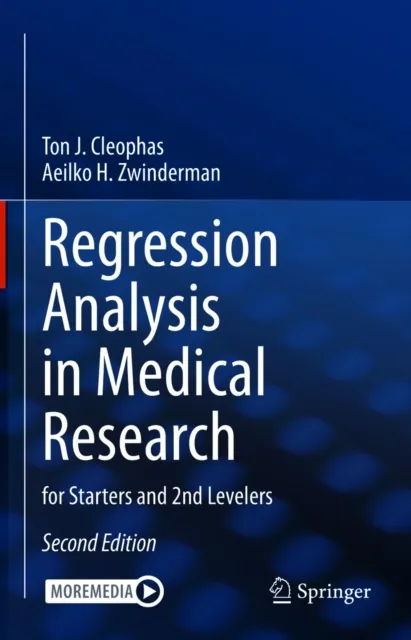
Regression Analysis in Medical Research
for Starters and 2nd Levelers

Introduction
This edition is a pretty complete textbook and tutorial for medical and health care students, as well as a recollection/update bench, and help desk for professionals. Novel approaches already applied in published clinical research will be addressed: matrix analyses, alpha spending, gate keeping, kriging, interval censored regressions, causality regressions, canonical regressions, quasi-likelihood regressions, novel non-parametric regressions. Each chapter can be studied as a stand-alone, and covers one field in the fast growing world of regression analyses.
Author Perspective
The authors, as professors in statistics and machine learning at European universities, are worried, that their students find regression-analyses harder than any other methodology in statistics. This is serious, because almost all of the novel methodologies in current data mining and data analysis include elements of regression-analysis. It is the main incentive for writing this 28 chapter edition, consistent of
- 28 major fields of regression analysis,
- their condensed maths,
- their applications in medical and health research as published so far,
- step by step analyses for self-assessment,
- conclusion and reference sections.
Regression Analysis in Practice
Traditional regression analysis is adequate for epidemiology, but lacks the precision required for clinical investigations. However, in the past two decades modern regression methods have proven to be much more precise. And so it is time, that a book described regression analyses for clinicians. The current edition is the first to do so. It is written for a non-mathematical readership. Self-assessment data-files are provided through Springer''s Extras Online.