£119.99
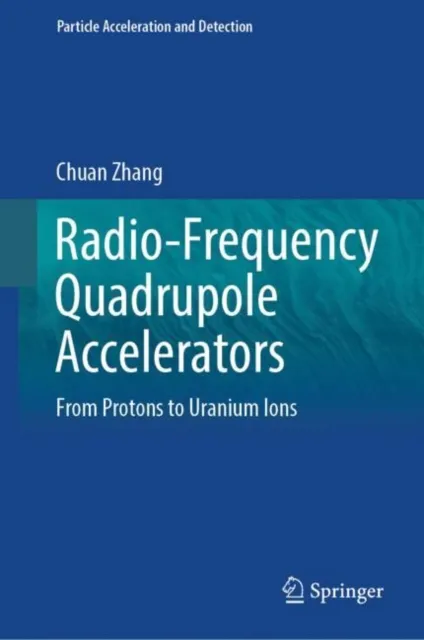
Radio-Frequency Quadrupole Accelerators
From Protons to Uranium Ions

Introduction
This book guides readers into the realm of particle accelerators, which have served as indispensable tools for fundamental research, energy development, medical therapy, industrial applications, national security, etc., since 1924. Towards a new generation of high power proton and ion accelerators, challenges often come from space charge effects, which are most pronounced in low-velocity beams.
Focus on RFQ Accelerators
This book focuses on Radio-Frequency Quadrupole (RFQ) accelerators, one of the most popular front-end structures for accelerator facilities, and their beam physics. Uncovering the limitations of the classic design methods, novel approaches to achieve efficient RFQ accelerators with high beam quality will be presented.
Future Developments
In addition, new ideas for possible future developments, such as how to realize long RFQs with high performance and how RFQs can be applied for much higher beam-velocities to shorten large-scale accelerators, will be introduced.
Research and Examples
To provide a general overview of the research and development of RFQs accelerating particle species from protons to uranium ions, this book uses over 10 real examples developed or proposed in the twenty-first century for various facilities of different dimensions (from large scale e.g. a collider to small scale e.g. university experimental setups).
Conclusion
With its rich content and comprehensive scope, this book is an invaluable reference for researchers and graduate students interested in RFQ accelerators and the intricacies of space charge physics in low-velocity beams.