£39.99
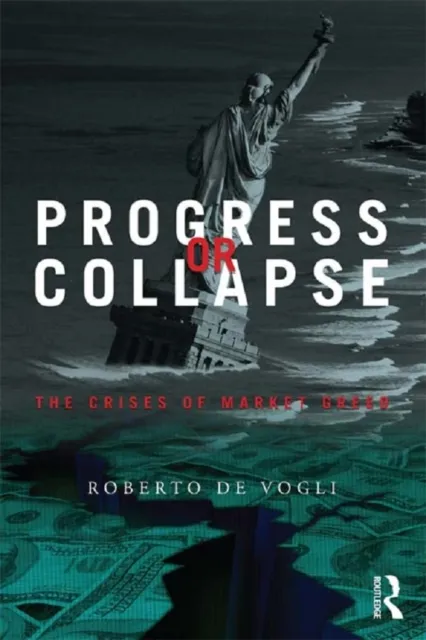
Progress or Collapse
The Crises of Market Greed

Human progress is heading toward collapse
There are converging ecological crises looming on the horizon: climate change, peak oil, water shortages, fish depletion and food scarcities. The world is on a collision course against the limits of the ecosystem. Modern societies are consuming, polluting and growing as if there is no tomorrow. Indeed, there may not be one.
About Progress or Collapse
Roberto De Vogli guides us through the multiple converging global crises of economic progress. He explores the connections between the environmental crisis and the psychological, social, cultural, political and economic emergencies affecting modern societies. It is not a coincidence, the author argues, that global ecological destruction is occurring in tandem with other crises: rising mental disorders, mindless consumerism, rampant conformism, status competition, civic disengagement, startling social inequalities, global financial instability, and widespread political impasse.
The root cause of societal breakdown
Roberto De Vogli identifies the root cause of all these symptoms of societal breakdown: neoliberalism, defined as market greed. He argues that in recent decades, modern societies have been dominated by a suicidal economic doctrine based on two articles of faith: the greed creed and the market God. The greed creed states that people are nothing but selfish profiteers in a perpetual search for status and wealth. The market God is the belief that all societal and human affairs are best regulated as market exchanges.
What is to be done?
Can we stop progress toward collapse? Given the current distribution of power and wealth, and the state of psychological and political inertia in which we are trapped, our chances of redefining progress around alternative values and embracing a new philosophy of life are slim. Yet, the history of human emancipation has often been shaped by giant leaps forward. In the past, civic struggles have overcome "the limits of the possible". Whether this will happen again in the future is the central question of our time.
Who will find this book of interest?
This book will be of interest to researchers and students of ecology, psychology, public health, epidemiology, human development, political philosophy, economics, sociology and politics.