£89.50
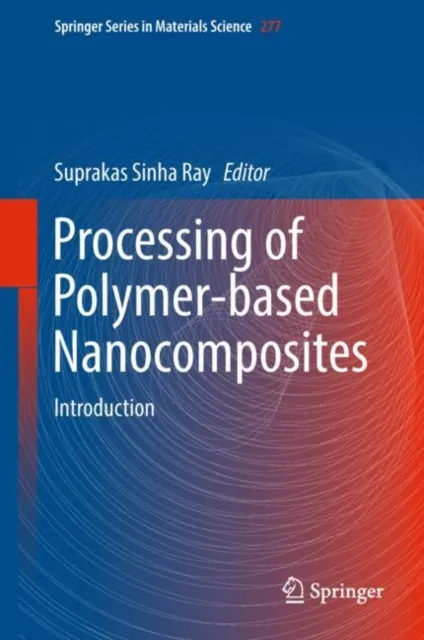
Processing of Polymer-based Nanocomposites
Introduction

Processing of polymer nanocomposites
Processing of polymer nanocomposites usually requires special attention since the resultant structure—micro- and nano-level, is directly influenced by among other factors, polymer/nano-additive chemistry and the processing strategy. This book consolidates knowledge, from fundamental to product development, on polymer nanocomposites processing with special emphasis on the processing-structure-property-performance relationships in a wide range of polymer nanocomposites. Furthermore, this book focuses on emerging processing technologies such as electrospinning, which has very exciting applications ranging from medical to filtration. Additionally, the important role played by the nanoparticles in polymer blends structures has been illustrated in the current book, with special focus on fundamental aspects and properties of nanoparticles migration and interface crossing in immiscible polymer blend nanocomposites.
This book introduces readers to nanomaterials and polymer nanocomposites processing
After defining nanoparticles and polymer nanocomposites and discussing environmental aspects, the second chapter focuses on the synthesis and functionalization of nanomaterials with applications in polymers. A brief overview on nanoclay and nanoclay-containing polymer nanocomposites is provided in third chapter. The fourth chapter provides an overview of the polymer nanocomposites structural elucidation techniques, such as X-ray diffraction and scattering, microscopy and spectroscopy, rheology. The fifth chapter is dedicated to the polymer nanocomposites processing technologies, among which electrospinning, which has very exciting applications ranging from medical to filtration. The last chapter provides an overview on how melt-processing strategy impact structure and mechanical properties of polymer nanocomposites by taking polypropylene-clay nanocomposite as a model system.
The book's target audience
The book is useful to undergraduate and postgraduate students (polymer engineering, materials science & engineering, chemical & process engineering), as well as research & development personnel, engineers, and material scientists.