£49.99
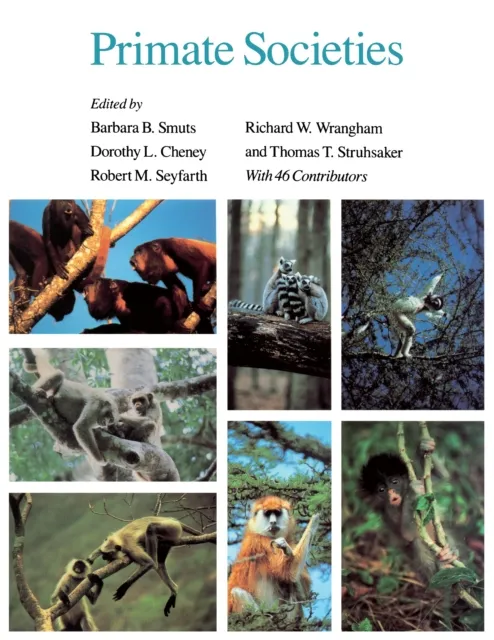
Primate Societies
Group Techniques of Ecological Adaptation

Introduction
In this book, Hans Kummer, one of the world's leading primate ethologists, examines the patterns of social interaction among primates. He examines this social behavior from the fundamentally biological viewpoint of evolutionary adaptation as part of the survival mechanisms for the species. Recognizing that all activity is constituted in part of genetic programming and in part of adaptive behavior, he explores the borderline area between the genetic and the "cultural."
Social Behavior and Inheritance
By use of astute observation and clever experimentation he shows that many aspects of social behavior are inherited, and differentially inherited among various primate groups. These data also show, however, that the individuals and troops learn much in primate social life and that these forms are responsive to particular ecological situations.
Primate Society and Studies
Drawing heavily on knowledge gleaned from his own well-known studies of the Hamadryas baboon, Dr. Kummer introduces the reader to the daily life of a particular primate society. From this sample case, he proceeds to a more general characterization of primate societies, using as examples the great apes and monkeys of Africa, Asia, and South America and particularly the widely studied terrestrial monkey species.
Communication and Social Structure
The particularities of primate communication, social structure, and economy are described and special attention is devoted to the primate counterparts of kinship and age groups—behavioral differences based on age and sex, and mating and grouping systems.
Ecological Functions of Social Life
This is followed by a chapter dealing with the ecological functions of the major parameters of primate social life, such as group size and the coordination of activities within it—dominance, leadership systems, and spatial arrangements.
Origins of Behavioral Traits
The second part of the book is concerned with the origins of behavioral traits of primates, discussed from phylogenetic, ecological, and cultural points of view, again using data-based examples. Dr. Kummer explains why some traits have not evolved that would have been ada