£46.50
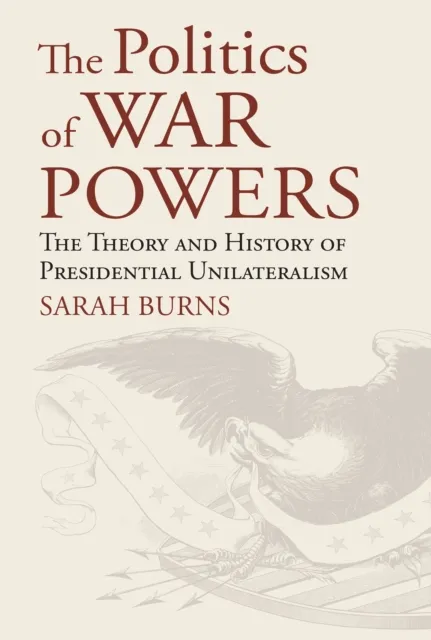
Politics of War Powers
The Theory and History of Presidential Unilateralism

The Constitution and War Powers
The Constitution of the United States divides war powers between the executive and legislative branches to guard against ill-advised or unnecessary military action. This division of powers compels both branches to hold each other accountable and work in tandem. And yet, since the Cold War, congressional ambition has waned on this front. Even when Congress does provide initial authorization for larger operations, they do not provide strict parameters or clear end dates. As a result, one president after another has initiated and carried out poorly developed and poorly executed military policy. The Politics of War Powers offers a measured, deeply informed look at how the American constitutional system broke down, how it impacts decision-making today, and how we might find our way out of this unhealthy power division.
Sarah Burns starts with a nuanced account of the theoretical and historical development of war powers in the United States. Where discussions of presidential power often lean on the concept of the Lockean Prerogative, Burns locates a more constructive source in Montesquieu. Unlike Locke, Montesquieu combines universal normative prescriptions with an emphasis on tailoring the structure to the unique needs of a society. In doing so, the separation of powers can be customized while maintaining the moderation needed to create a healthy institutional balance. He demonstrates the importance of forcing the branches into dialogue, putting them, as he says, “in a position to resist” each other. Burns’s conclusion—after tracing changes through Franklin Delano Roosevelt’s administration, the Cold War, and the War on Terror—is that presidents now command a dangerous degree of unilateral power.
Burns’s work ranges across Montesquieu’s theory, the debate over the creation of the Constitution, historical precedent, and the current crisis. Through her analysis, both a fuller picture of the alterations to the constitutional system and ideas on how to address the resulting imbalance of power emerge.