£0.99
Pointe du Hoc, 1944

The Attack on Pointe du Hoc
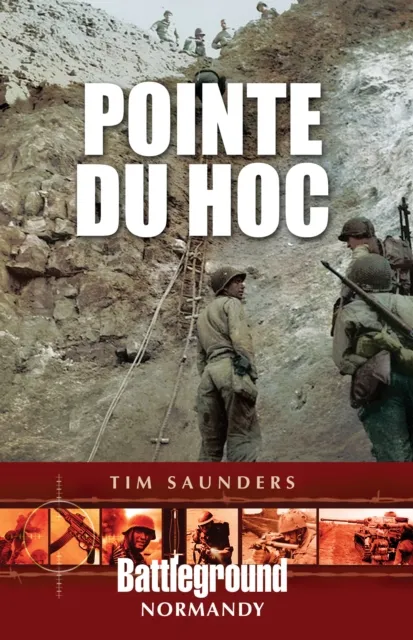
The attack by Rudder's Rangers on Pointe du Hoc, as one of the opening acts of D Day, is without doubt an epic of military history. As a result of Montgomery's upscaling of the invasion, General Bradley's First US Army had to deal with a dangerous coastal gun battery that would dominate the approaches to both Omaha and Utah Beaches. When the plan to climb the defended cliff and put the guns out of action was first discussed, an astounded staff officer said, "Two old ladies with brooms could sweep them off those cliffs!"
Lieutenant Colonel James Rudder, commander of the Provisional Ranger Group consisting of 2nd and 5th US Rangers, set about training his men and developing techniques to get up the hundred-foot-high cliff. Rocket-fired grapples, ladders of various types, and even free climbing of a similar loose cliff on England's south coast were practiced.
On D-Day, everything that could go wrong did go wrong. Lesser men would have given up, with the force having navigated towards the wrong headland, been continuously under fire as they motored back towards Pointe du Hoc, shipping water in the rough seas, craft sinking, and few of the saturated grapples reaching the cliff top. Nonetheless, determined Rangers with German infantry hurling grenades down on them struggled up the cliff, but the guns were not there.
With the Rangers fanning out across the wrecked battery and into the fields beyond, the guns were found in an orchard and destroyed with thermite grenades. Mission accomplished, but at 1300 hours, there was no sign of the relieving force from Omaha. Colonel Rudder, with his radios barely working, appealed for help, but with a near disaster at Omaha, neither help nor relief was forthcoming. Consequently, the 200 Rangers fought on against mounting pressure in an equally epic battle until finally relieved two days later.


![OMAHA BEACHHEAD - (6 June-13 June 1944) [Illustrated Edition]](/covers/images/a8c26097a46ff2653edaa833fd5adfc5566adf84ee15f3c339ac2e4070733cc7.webp)
![UTAH BEACH TO CHERBOURG - 6-27 JUNE 1944 [Illustrated Edition]](/covers/images/a8c26097a46ff2653edaa833fd5adfc5ef5acf019418aa7f4d7632a2889b99cf.webp)



![FIGHT AT THE LOCK [Illustrated Edition]](/covers/images/a8c26097a46ff2653edaa833fd5adfc5ddac9f4b3c106263d9e0d3782b2555a2.webp)