£54.99
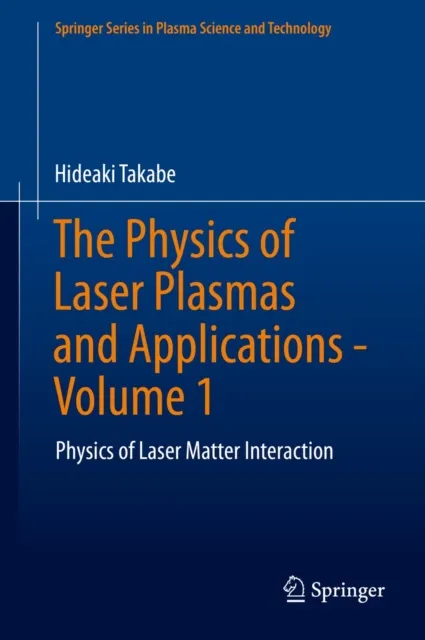
Physics of Laser Plasmas and Applications - Volume 1
Physics of Laser Matter Interaction

Series Content Overview
The series of books discusses the physics of laser and matter interaction, fluid dynamics of high-temperature and high-density compressible plasma, and kinetic phenomena and particle dynamics in laser-produced plasma. The book (Vol.1) gives the physics of intense-laser absorption in matter and/or plasma in non- relativistic and relativistic laser-intensity regime. In many cases, it is explained with clear images of physics so that an intuitive understanding of individual physics is possible for non-specialists.
Laser Intensity and Absorption
For intense-laser of 1013-16 W/cm2, the laser energy is mainly absorbed via collisional process, where the oscillation energy is converted to thermal energy by non-adiabatic Coulomb collision with the ions. Collisionless interactions with the collective modes in plasma are also described. The main topics are the interaction of ultra-intense laser and plasma for the intensity near and over 1018 W/cm2. In such regime, relativistic dynamics become essential.
Relativistic Effects and New Physics
A new physics appears due to the relativistic effects, such as mass correction, relativistic nonlinear force, chaos physics of particle motions, and so on. The book provides clearly the theoretical base for challenging the laser-plasma interaction physics in the wide range of power lasers.
Target Audience
It is suitable as a textbook for upper-undergraduate and graduate students as well as for readers who want to understand the whole physics structure about what happen when an intense-laser irradiates any materials including solids, gas etc. Explaining the physics intuitively without complicated mathematics, it is also a valuable resource for engineering students and researchers as well as for self-study.