£14.95
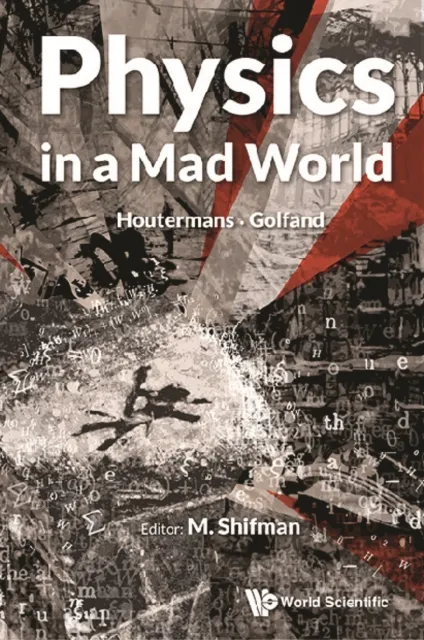
Physics In A Mad World

Introduction
This book tells captivating stories of misadventures of two renowned theoretical physicists in the Soviet Union.
Friedrich (Fritz) Houtermans
An outstanding Dutch-Austrian-German physicist who was the first to suggest that the source of stars' energy is thermonuclear fusion, and also made a number of other important contributions to cosmochemistry and geochemistry.
In 1935, Houtermans, a German communist, in an attempt to save his life from Hitler's Gestapo, fled to the Soviet Union. He took up an appointment at the Kharkov Physico-Technical Institute, working there for two years with the Russian physicist Valentin P Fomin.
In the Great Purge of 1937, Houtermans was arrested in December by the NKVD (Soviet Secret Police, KGB's predecessor). He was tortured, and confessed to being a Trotskyist plotter and German spy, out of fear of threats against his wife Charlotte. However, Charlotte had already escaped from the Soviet Union to Denmark, after which she went to England and finally the USA.
As a result of the Hitler-Stalin Pact of 1939, Houtermans was turned over to the Gestapo in May 1940 and imprisoned in Berlin.
Yuri Golfand
The second part consists of two essays that narrate the life story of Yuri Golfand, one of the codiscoverers of supersymmetry, a major discovery in theoretical physics in the 20th century.
In 1973, just two years after the publication of his seminal paper, he was fired from the Lebedev Physics Institute in Moscow. Because of his Jewish origin he could find no job. Under such circumstances, he applied for an exit visa to Israel, but his application was denied.
Yuri Golfand became a refusnik and joined the Human rights movement, along with two other prominent physicists, Andrei Sakharov and Yuri Orlov. To earn his living, he had to do manual work, repeatedly being intimidated by KGB. Only 18 years later, shortly before the demise of the Soviet Union, did he obtain permission to leave the country, emigrating to Israel in 1990.
Conclusion
These personal life stories of two outstanding theorists are intertwined with the tragedies of the 20th century and make for compelling reading.