£15.96
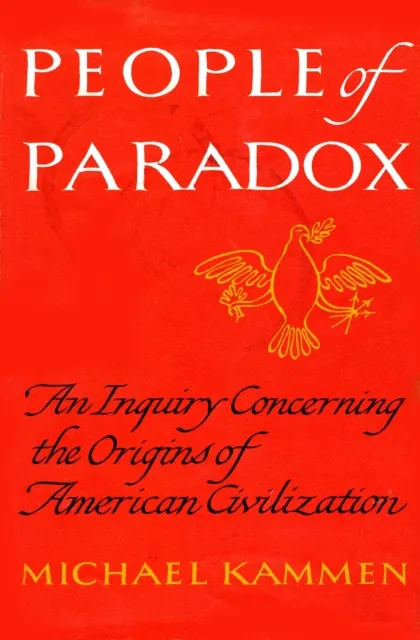
People of Paradox

Introduction
In this major interpretive work Mr. Kammen argues that most attempt to understand America’s history and culture have minimized its complexity, and he demonstrates that, from our beginnings, what has given our culture its distinctive texture, pattern, and thrust is the dynamic interaction of the imported and the indigenous. He shows now, during the years of colonization, especially in the century from 1660 to 1760, many ideas and institutions were transferred virtually unchanged from Britain, while, simultaneously, others were being transformed in the New World environment.
Unraveling American Culture
As he unravels the tangled origins of our “bittersweet” culture, Mr. Kammen makes us see that unresolved contradictions in the American experience have functioned as the prime characteristic of our national style. Puritanical and hedonistic, idealistic and materialistic, peace-loving and war-mongering, isolationist and interventionist, consensus-minded and conflict-prone—these opposing strands go back to the roots of our history. He pursues them down through the seventeenth and eighteenth centuries—from the traumas of colonization and settlement through the tensions of the American Revolution—making clear both the relevance of this early experience to nineteenth and twentieth-century realities and the way in which America’s dualisms have endured and accumulated to produce such dilemmas as today’s poverty amidst abundance and legitimized lawlessness.
Conclusion
Far from being a study in social pathology, People of Paradox is a depiction of a complex society and an explanation of its development—a bold interpretation that gives an entirely new perspective to the American ethos.