£54.99
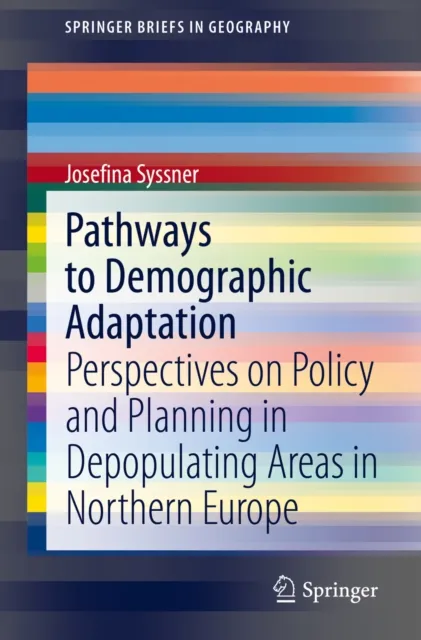
Pathways to Demographic Adaptation
Perspectives on Policy and Planning in Depopulating Areas in Northern Europe

Introduction
This book builds on case studies in depopulating and shrinking areas in Northern Europe. While most contemporary literature on shrinkage focuses on these issues from a planning standpoint, this book uniquely applies a policy perspective when approaching the material. The book assesses the potential of demographic adaptation policies to manage depopulation, that is, policy programs aiming at managing depopulation through adaptation, rather than through growth policies intended to foster population growth. In 6 chapters, the book acts as an up-to-date resource on demographic adaptation for master and Ph.D. students, researchers, and practitioners working in local and regional development, governance, and planning.
Chapter 1
Gives an overview of recent demographic trends in Northern Europe and introduces the theoretical differences between growth policy and adaptation policy.
Chapter 2
Accounts for the policy concept and introduces a framework for how local adaptation policies could be systematically analysed.
Chapter 3
Suggests that the Nordic welfare states exhibit two characteristics that prove to be relevant when discussing the consequences and policy implications of demographic decline, i.e. an extremely sparse population structure and an ambitious welfare assignment that in many respects has been devolved to the local level of government.
Chapter 4
Suggests that whether shrinkage constitutes a problem or not depends upon the interpretations of those in power, but also upon political, economic and geographic conditions.
Chapter 5
Seeks to understand why local level policymakers avoid developing strategies for how to handle long-term population decline.
Chapter 6
Summarizes the points of the previous chapters, and concludes that local governments in shrinking areas ought to develop local adaptation policies. These policies, however, also need to be subjected to critical analysis, and the chapter introduces a model for how local adaptation policy priorities could be assessed in a more structured manner.