£199.50
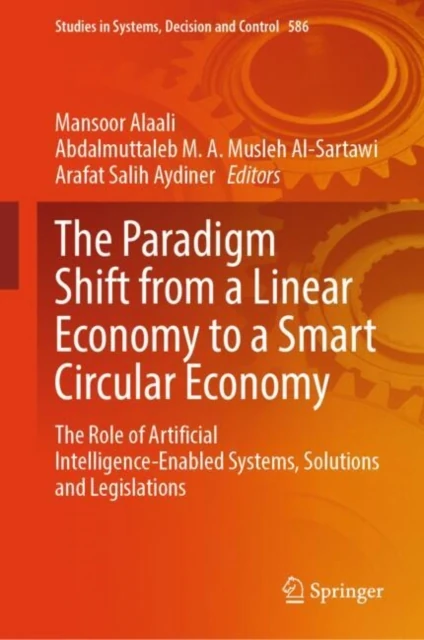
Paradigm Shift from a Linear Economy to a Smart Circular Economy
The Role of Artificial Intelligence-Enabled Systems, Solutions and Legislations

Introduction to the Circular Economy
The concept of the circular economy has attracted the attention of scholars, researchers, professionals, and policymakers in recent years. The notion is characterised as an economy that intends to keep products, stocks, work in progress and materials at their highest utility and value continually, distinguishing between their technical and biological cycles. It is devised as a continuous positive development cycle that reserves and improves natural resources, optimizes outputs, and minimizes supply chain related risks by overseeing limited stocks and renewable flows of the stocks.
Legislations and Policies
Several legislations and policies are being developed to motivate and integrate SDGs and net zero-related approaches in companies, among which the circular economy (CE) is gaining momentum due to its documented impact on the elements of the SDGs and net zero.
Role of Artificial Intelligence
Efficient management of resources and utility via artificial intelligence is vital towards a smart circular economy by minimising waste/losses, pollution, and extraction of virgin resources. It is important to note that there is a difference between smart and traditional circular economies. This book focuses on the former and makes distinctions in terms of how technology systems and solutions can be effectively and efficiently implemented.
About the Book
This book “The Paradigm Shift from a Linear Economy to a Smart Circular Economy: The Role of Artificial Intelligence-Enabled Systems, Solutions and Legislations” discusses the transition from linear to smart circular economy by dissecting the role of artificial intelligence and other technologies such as big data, IoT and blockchain in such transformations. The book further aims to provide a platform for researchers, professionals, and students to closely investigate, discuss and examine the theories, philosophies, ontologies and the role of governments, policymakers, and businesses in supporting the transition to a smart economy via national initiatives, fiscal policies, and corporate governance.
The book highlights the need for collaborative efforts between various actors including the private and public sectors through cross-disciplinary approaches to attain, maintain and sustain a smart circular economy.