£199.99
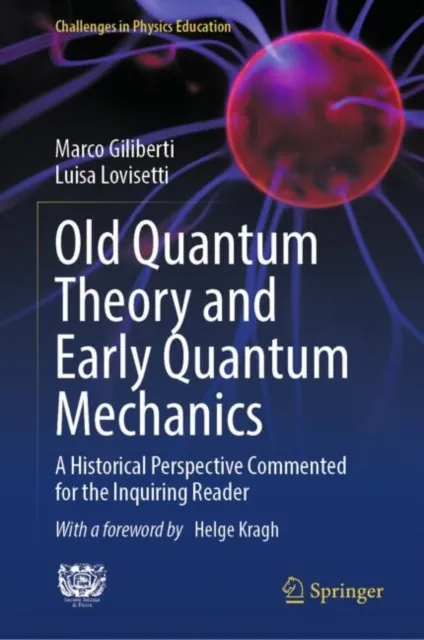
Old Quantum Theory and Early Quantum Mechanics
A Historical Perspective Commented for the Inquiring Reader

Overview
This book provides a historical presentation of Old Quantum Theory and
early Quantum Mechanics integrated with comments and examples that help
contextualize and understand the physics discussed.
It consists in a detailed analysis of the usual topics that have most
contributed to the birth and the development of Quantum Mechanics
(black-body spectrum, atomic models, EPR paradox, etc.), but also dealing
with ideas, concepts and results that are not usually treated (vortex
atoms, discussion on the meaning of the term “electron”, non-quantum
models of the Compton effect, etc.). The time span taken into
consideration goes mainly from the 1880s to the 1940s; but some brief
notes on more recent results are also presented in the appendixes.
The work is based on nearly 800 original documents – books, papers, letters,
newspapers – whose content is not only partially reported, but also
explained, and inserted in the historical, social and disciplinary context
of the time. Together with a rigorous historical framework, the book
offers also an educational discussion of the physical aspects presented.
Indeed, there are some specific sections and subsections with pedagogical
observations.
This book is intended for students pursuing STEM degrees, particularly
those seeking an understanding of the genesis and rationale behind quantum
mechanics. But it is surely also addressed to professional physicists who
are eager to reconsider the cultural foundations underlying the quantum
view of the world. We are thus thinking of inquiring minds, people who
teach quantum physics, and individuals involved in quantum technologies.