£114.00
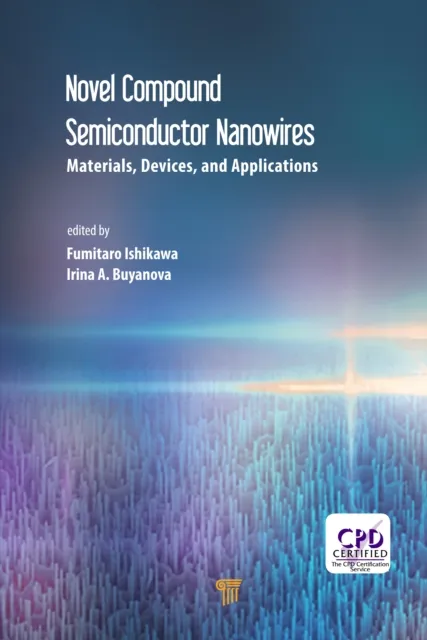
Novel Compound Semiconductor Nanowires
Materials, Devices, and Applications

Introduction
One dimensional electronic materials are expected to be key components owing to their potential applications in nanoscale electronics, optics, energy storage, and biology. Besides, compound semiconductors have been greatly developed as epitaxial growth crystal materials. Molecular beam and metalorganic vapor phase epitaxy approaches are representative techniques achieving 0D–2D quantum well, wire, and dot semiconductor III-V heterostructures with precise structural accuracy with atomic resolution. Based on the background of those epitaxial techniques, high-quality, single-crystalline III-V heterostructures have been achieved.
III-V Nanowires and Device Applications
III-V Nanowires have been proposed for the next generation of nanoscale optical and electrical devices such as nanowire light emitting diodes, lasers, photovoltaics, and transistors. Key issues for the realization of those devices involve the superior mobility and optical properties of III-V materials (i.e., nitride-, phosphide-, and arsenide-related heterostructure systems). Further, the developed epitaxial growth technique enables electronic carrier control through the formation of quantum structures and precise doping, which can be introduced into the nanowire system.
Growth Techniques and Material Systems
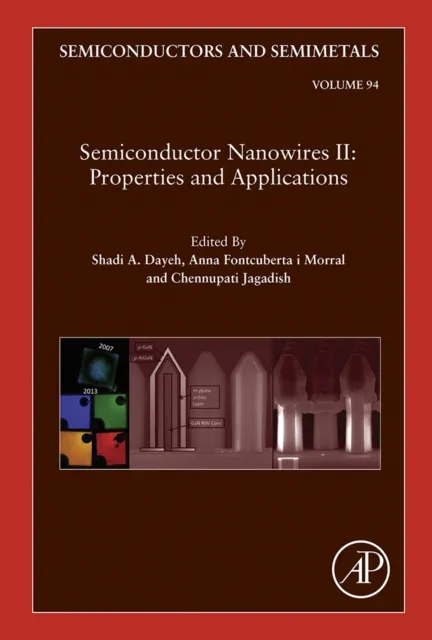
The growth can extend the functions of the material systems through the introduction of elements with large miscibility gap, or, alternatively, by the formation of hybrid heterostructures between semiconductors and another material systems. This book reviews recent progresses of such novel III-V semiconductor nanowires, covering a wide range of aspects from the epitaxial growth to the device applications. Prospects of such advanced 1D structures for nanoscience and nanotechnology are also discussed.