£149.50
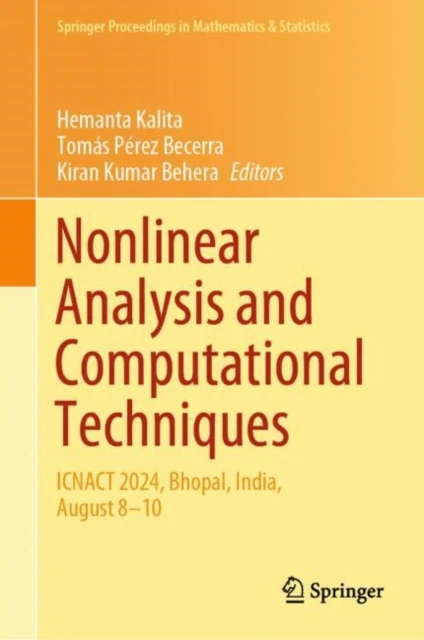
Nonlinear Analysis and Computational Techniques
ICNACT 2024, Bhopal, India, August 8-10

Proceedings and Conference Details
This book contains proceedings of select chapters presented at the International Conference on Nonlinear Analysis & Computational Techniques (ICNACT-2024), held at VIT Bhopal University, Madhya Pradesh, India, from 8 to 10 August 2024.
Topics Covered
It discusses advances, emerging trends and theoretical developments in topics related to nonlinear analysis and computational techniques, including the introduction to new function spaces, such as a generalized Orlicz with Rao and Ren’s norm, the s-Young space and the controlled G-metric spaces. The book explains some relationships among different types of near linear spaces and introduces the strongly λ-summable functions.
Nonlinear Systems and Convergence
Nonlinear systems frequently require convergence and fixed point theorems. In this sense, the concept of q-lacunary almost statistical convergence is exposed. The book proposes a common coupled fixed point theorems, a few fixed point theorems for compatible mappings of type P and some applications on dynamic programming.
Applications in Differential Equations
In differential equations, some works extend Ostrowski-type inequalities; solution of the fractal nonlinear Klein–Gordon equation, study of a hybrid differential equation and the problem of exponential stability of the nonlinear Saint–Venant equation, finally provides a study of some properties for Cayley transform of operators.
Intended Audience
The book is useful to researchers in mathematics and applied sciences, engineers, graduate students, computational scientists, software developers and educators. They will benefit from this theory, which is essential for efficiently solving complex equations via the understanding, modeling and solving nonlinear problems and their theoretical and practical domains.