£119.99
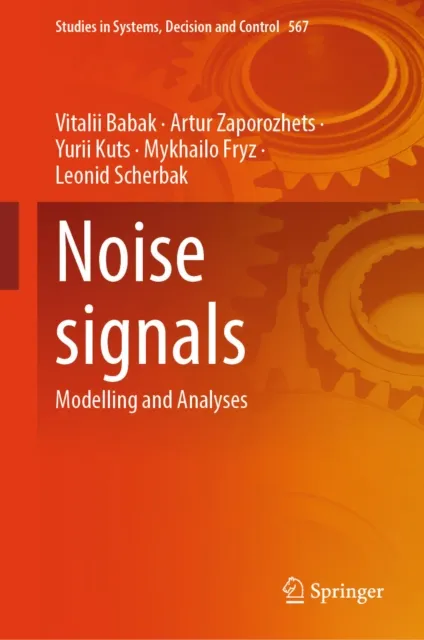
Noise signals
Modelling and Analyses

Overview of the Mathematical Model
The book meticulously details a constructive mathematical model of a stochastic noise process, specifically a linear random process and its characteristics. Theoretical reasoning on the relationship between random processes with independent increments and those with independent values, known as random processes of white noise, is provided.
Characteristics of Linear Random Processes
The model of a linear random process serves as a mathematical representation of colored noises in various hues. Characteristics of both non-stationary and stationary linear random processes are elucidated, with emphasis on their ergodic properties, crucial for practical applications.
Vector Linear Random Process and New Contributions
The study also encompasses the vector linear random process, portraying a model of multi-channel noise signals. A novel contribution to the theory of random functions is the development of a constructive model of a conditional linear random process. This involves determining its distribution laws in the form of a characteristic function and relevant statistical characteristics, which can serve as potential indicators for identifying stochastic noise processes.
Periodic Stochastic Models and Signal Identification
The book revisits research on periodic stochastic models, examining cyclic, rhythmic, natural, and artificial phenomena, processes, and signals. A comprehensive analysis of the linear periodic random process is conducted, and the identification characteristics of periodic models of stochastic noise signals are explored. Significant attention is directed toward employing contour and phase methods as a theoretical foundation for addressing narrow-band noise signal identification challenges.