£190.00
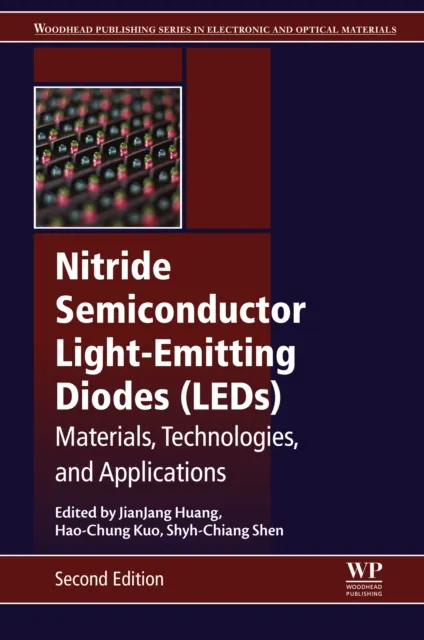
Nitride Semiconductor Light-Emitting Diodes (LEDs)
Materials, Technologies and Applications

Introduction
The development of nitride-based light-emitting diodes (LEDs) has led to advancements in high-brightness LED technology for solid-state lighting, handheld electronics, and advanced bioengineering applications. Nitride Semiconductor Light-Emitting Diodes (LEDs) reviews the fabrication, performance, and applications of this technology that encompass the state-of-the-art material and device development, and practical nitride-based LED design considerations.
Part One: Fabrication
Part one reviews the fabrication of nitride semiconductor LEDs. Chapters cover molecular beam epitaxy (MBE) growth of nitride semiconductors, modern metalorganic chemical vapor deposition (MOCVD) techniques and the growth of nitride-based materials, and gallium nitride (GaN)-on-sapphire and GaN-on-silicon technologies for LEDs. Nanostructured, non-polar and semi-polar nitride-based LEDs, as well as phosphor-coated nitride LEDs, are also discussed.
Part Two: Performance
Part two covers the performance of nitride LEDs, including photonic crystal LEDs, surface plasmon enhanced LEDs, color tuneable LEDs, and LEDs based on quantum wells and quantum dots. Further chapters discuss the development of LED encapsulation technology and the fundamental efficiency droop issues in gallium indium nitride (GaInN) LEDs.
Part Three: Applications
Finally, part three highlights applications of nitride LEDs, including liquid crystal display (LCD) backlighting, infrared emitters, and automotive lighting.
Target Audience
Nitride Semiconductor Light-Emitting Diodes (LEDs) is a technical resource for academics, physicists, materials scientists, electrical engineers, and those working in the lighting, consumer electronics, automotive, aviation, and communications sectors.