£99.50
MRI of Short- and Ultrashort-T2 Tissues
Making the Invisible Visible

Introduction to MRI Techniques
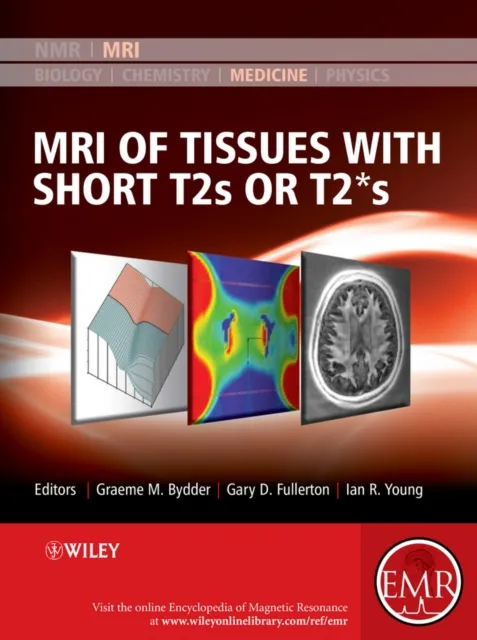
This book comprehensively covers ultrashort echo time (UTE), zero echo time (ZTE), and other magnetic resonance imaging (MRI) acquisition techniques for imaging of short and ultrashort-T2 tissues. MRI uses a large magnet and radio waves to generate images of tissues in the body. The MRI signal is characterized by two time constants, spin-lattice relaxation time (T1) which describes how fast the longitudinal magnetization recovers to its initial value after tipping to the transverse plane, and spin-spin relaxation time (T2) which describes how fast the transverse magnetization decays. Conventional MRI techniques have been developed to image and quantify tissues with relatively long T2s. However, the body also contains many tissues and tissue components such as cortical bone, menisci, ligaments, tendons, the osteochondral junction, calcified tissues, lung parenchyma, iron containing tissues, and myelin, which have short or ultrashort-T2s. These tissues are “invisible” with conventional MRI, and their MR and tissue properties are not measurable. UTE and ZTE type sequences resolve these challenges and make these tissues visible and quantifiable.
Contents of the Book
This book first introduces the basic physics of conventional MRI as well as UTE and ZTE type MRI, including radiofrequency excitation, data acquisition, and image reconstruction. A series of contrast mechanisms are then introduced and these provide high resolution, high contrast imaging of short and ultrashort-T2 tissues. A series of quantitative UTE imaging techniques are described for measurement of MR tissue properties (proton density, T1, T2, T2*, T1p, magnetization transfer, susceptibility, perfusion and diffusion). Finally, clinical applications in the musculoskeletal, neurological, pulmonary and cardiovascular systems are described.
Intended Audience
This is an ideal guide for physicists and radiologists interested in learning more about the use of UTE and ZTE type techniques for MRI of short and ultrashort-T2 tissues.