£129.50
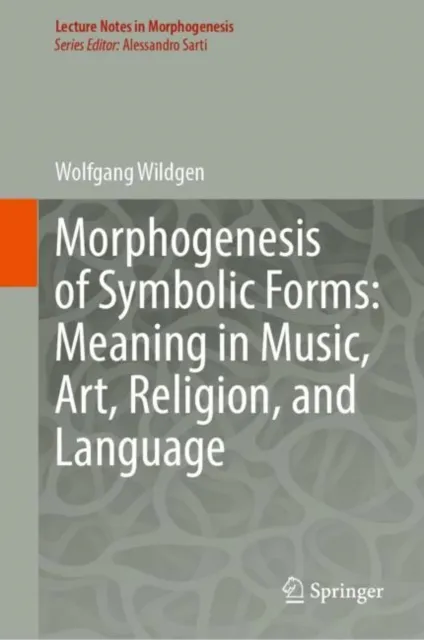
Morphogenesis of Symbolic Forms: Meaning in Music, Art, Religion, and Language

Introduction
In the present book, the starting line is defined by a morphogenetic perspective on human communication and culture. The focus is on visual communication, music, religion (myth), and language, i.e., on the “symbolic forms” at the heart of human cultures (Ernst Cassirer). The term “morphogenesis” has more precisely the meaning given by René Thom (1923-2002) in his book “Morphogenesis and Structural Stability” (1972) and the notions of “self-organization” and cooperation of subsystems in the “Synergetics” of Hermann Haken (1927- ). The naturalization of communication and cultural phenomena is the favored strategy, but the major results of the involved disciplines (art history, music theory, religious science, and linguistics) are respected.
Visual Art and Music
Visual art from the Paleolithic to modernity stands for visual communication. The present book focuses on studies of classical painting and sculpture (e.g., Leonardo da Vinci, William Turner, and Henry Moore) and modern art (e.g., Jackson Pollock and Joseph Beuys). Musical morphogenesis embraces classical music (from J. S. Bach to Arnold Schönberg) and political songwriting (Bob Dylan, Leonhard Cohen). The myths of pre-literary societies show the effects of self-organization in the re-assembly (bricolage) of traditions.
Religious and Cultural Networks
Classical polytheistic and monotheistic religions demonstrate the unfolding of basic germs (religious attractors) and their reduction in periods of crisis, the self-organization of complex religious networks, and rationalized macro-structures (in theologies). Significant tendencies are analyzed in the case of Buddhism and Christianism. Eventually, a holistic view of symbolic communication and human culture emerges based on state-of-the-art in evolutionary biology, cognitive science, linguistics, and semiotics (philosophy of symbolic forms).