£74.50
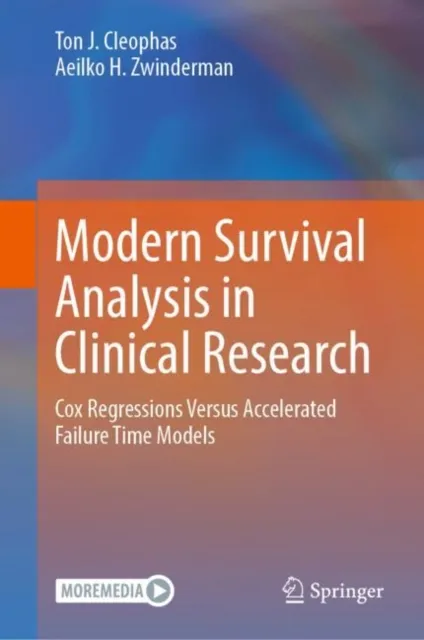
Modern Survival Analysis in Clinical Research
Cox Regressions Versus Accelerated Failure Time Models

Introduction to Accelerated Failure Time (AFT) Models
An important novel menu for Survival Analysis entitled Accelerated Failure Time (AFT) models has been published by IBM (International Business Machines) in its SPSS statistical software update of 2023. Unlike the traditional Cox regressions that work with hazards, which are the ratio of deaths and non-deaths in a sample, it works with risk of death, which is the proportion of deaths in the same sample. The latter approach may provide better sensitivity of testing, but has been seldom applied, because with computers risks are tricky and hazards because they are odds are fine. This was underscored in 1997 by Keiding and colleague statisticians from Copenhagen University who showed better-sensitive goodness of fit and null-hypothesis tests with AFT than with Cox survival tests.
Current Research and Educational Resources
So far, a controlled study of a representative sample of clinical Kaplan Meier assessments, where the sensitivity of Cox regression is systematically tested against that of AFT modeling, has not been accomplished. This edition is the first textbook and tutorial of AFT modeling both for medical and healthcare students and for professionals. Each chapter can be studied as a standalone, and, using real as well as hypothesized data, it tests the performance of the novel methodology against traditional Cox regressions. Step by step analyses of over 20 data files stored at Supplementary Files at Springer Interlink are included for self-assessment.
Author Qualifications and Expertise
We should add that the authors are well qualified in their field. Professor Zwinderman is past-president of the International Society of Biostatistics (2012-2015) and Professor Cleophas is past-president of the American College of Angiology (2000-2002). From their expertise they should be able to make adequate selections of modern data analysis methods for the benefit of physicians, students, and investigators. The authors have been working and publishing together for 25 years and their research can be characterized as a continued effort to demonstrate that clinical data analysis is not mathematics but rather a discipline at the interface of biology and mathematics.