£49.99
Modern Special Relativity
A Student's Guide with Discussions and Examples

This book presents Special Relativity in a language accessible to students while avoiding the burdens of geometry, tensor calculus, space-time symmetries, and the introduction of four vectors. The search for clarity in the fundamental questions about Relativity, the discussion of historical developments before and after 1905, the strong connection to current research topics, many solved examples and problems, and illustrations of the material in colloquial discussions are the most significant and original assets of this book. Importantly for first-time students, Special Relativity is presented such that nothing needs to be called paradoxical or apparent; everything is explained.
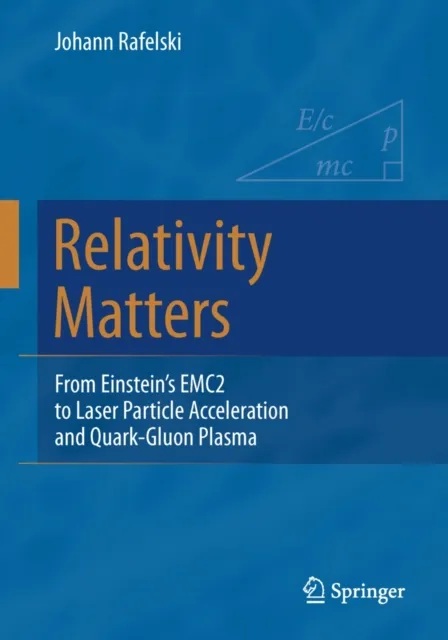
The content of this volume develops and builds on the book Relativity Matters (Springer, 2017). However, this presentation of Special Relativity does not require 4-vector tools. The relevant material has been extended and reformulated, with additional examples and clarifications.
This introduction of Special Relativity offers conceptual insights reaching well beyond the usual method of teaching relativity. It considers relevant developments after the discovery of General Relativity (which itself is not presented), and advances the reader into contemporary research fields. This presentation of Special Relativity is connected to present day research topics in particle, nuclear, and high intensity pulsed laser physics and is complemented by the current cosmological perspective. The conceptual reach of Special Relativity today extends significantly further compared even to a few decades ago.
As the book progresses
The qualitative and historical introduction turns into a textbook-style presentation with many detailed results derived in an explicit manner. The reader reaching the end of this text needs knowledge of classical mechanics, a good command of elementary algebra, basic knowledge of calculus, and introductory know-how of electromagnetism.