£129.50
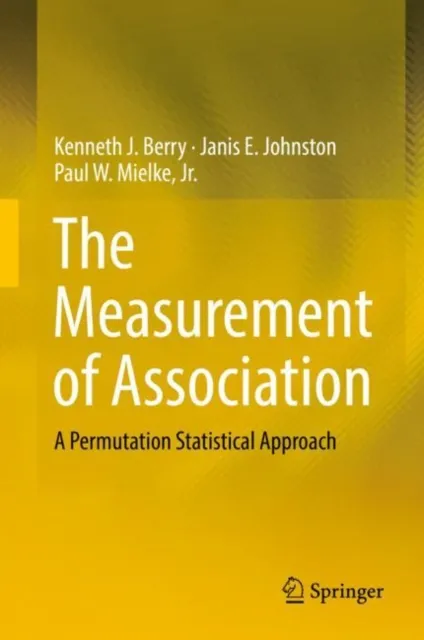
Measurement of Association
A Permutation Statistical Approach

Research Methods and Scope
This research monograph utilizes exact and Monte Carlo permutation statistical methods to generate probability values and measures of effect size for a variety of measures of association. Association is broadly defined to include measures of correlation for two interval-level variables, measures of association for two nominal-level variables or two ordinal-level variables, and measures of agreement for two nominal-level or two ordinal-level variables. Additionally, measures of association for mixtures of the three levels of measurement are considered: nominal-ordinal, nominal-interval, and ordinal-interval measures. Numerous comparisons of permutation and classical statistical methods are presented.
Advantages of Permutation Methods
Unlike classical statistical methods, permutation statistical methods do not rely on theoretical distributions, avoid the usual assumptions of normality and homogeneity of variance, and depend only on the data at hand. This book takes a unique approach to explaining statistics by integrating a large variety of statistical methods, and establishing the rigor of a topic that to many may seem to be a nascent field. This topic is relatively new in that it took modern computing power to make permutation methods available to those working in mainstream research.
Intended Audience and Applications
Written for a statistically informed audience, it is particularly useful for teachers of statistics, practicing statisticians, applied statisticians, and quantitative graduate students in fields such as psychology, medical research, epidemiology, public health, and biology. It can also serve as a textbook in graduate courses in subjects like statistics, psychology, and biology.