£109.50
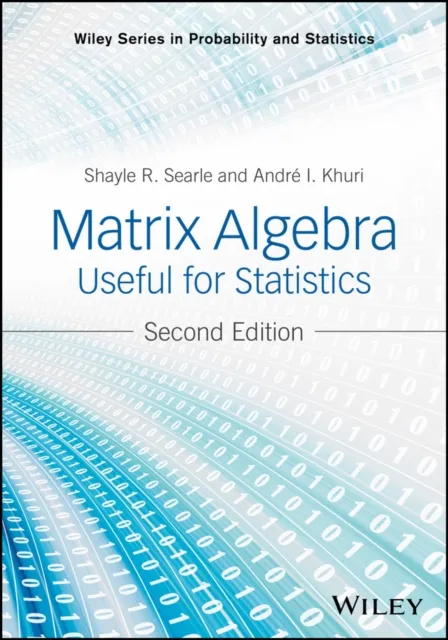
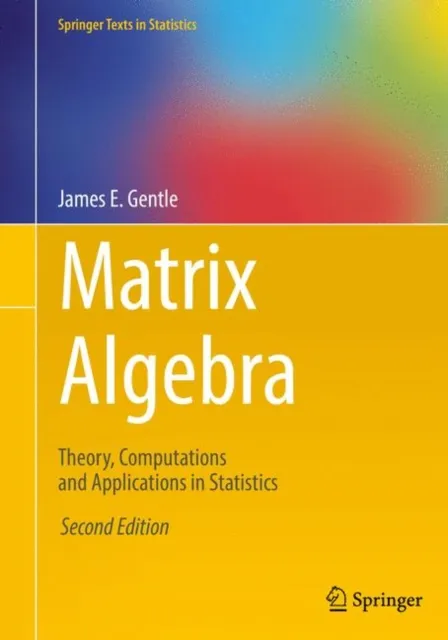
Matrix Algebra
Theory, Computations and Applications in Statistics

Introduction
This textbook for graduate and advanced undergraduate students presents the theory of matrix algebra for statistical applications, explores various types of matrices encountered in statistics, and covers numerical linear algebra. Matrix algebra is one of the most important areas of mathematics in data science and in statistical theory, and the second edition of this very popular textbook provides essential updates and comprehensive coverage on critical topics in mathematics in data science and in statistical theory.
Part I
Part I offers a self-contained description of relevant aspects of the theory of matrix algebra for applications in statistics. It begins with fundamental concepts of vectors and vector spaces; covers basic algebraic properties of matrices and analytic properties of vectors and matrices in multivariate calculus; and concludes with a discussion on operations on matrices in solutions of linear systems and in eigenanalysis.
Part II
Part II considers various types of matrices encountered in statistics, such as projection matrices and positive definite matrices, and describes special properties of those matrices; and describes various applications of matrix theory in statistics, including linear models, multivariate analysis, and stochastic processes.
Part III
Part III covers numerical linear algebra—one of the most important subjects in the field of statistical computing. It begins with a discussion of the basics of numerical computations and goes on to describe accurate and efficient algorithms for factoring matrices, how to solve linear systems of equations, and the extraction of eigenvalues and eigenvectors.
Software and Programming
Although the book is not tied to any particular software system, it describes and gives examples of the use of modern computer software for numerical linear algebra. This part is essentially self-contained, although it assumes some ability to program in Fortran or C and/or the ability to use R or Matlab.
Target Audience
The first two parts of the text are ideal for a course in matrix algebra for statistics students or as a supplementary text for various courses in linear models or multivariate statistics. The third part is ideal for use as a text for a course in statistical computing or as a supplementary text for various courses that emphasize computations.
New to this edition
• 100 pages of additional material
• 30 more exercises—186 exercises overall
• Added discussion of vectors and matrices with complex elements
• Additional material on statistical applications
• Extensive and reader-friendly cross references and index