£119.99
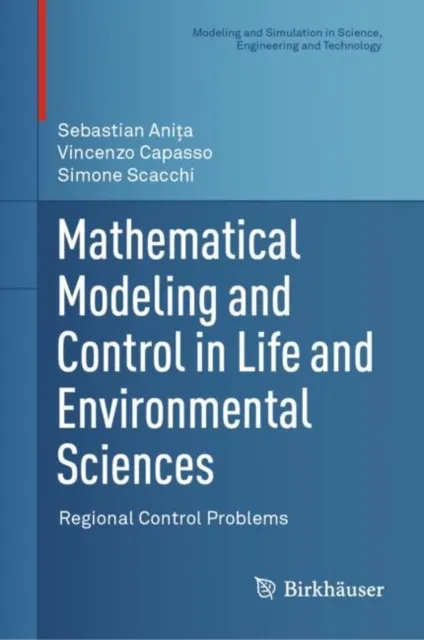
Mathematical Modeling and Control in Life and Environmental Sciences
Regional Control Problems

Introduction
This monograph explores the use of mathematical modeling and control theory in a variety of contemporary challenges in mathematical biology and environmental sciences. Emphasizing an approach of learning by doing, the authors focus on a set of significant case studies emerging from real-world problems and illustrate how mathematical techniques and computational experiments can be employed in the search for sustainable solutions.
Topics Covered
The following topics are extensively discussed:
- Eradicability and control of a paradigmatic epidemic model, with a view to the existence of endemic states, their stability, and the existence of travelling waves
- A spatially structured epidemic model concerning malaria as an example of vector-borne epidemics
- Optimal harvesting problems for space-structured and age-structured population dynamics
- Controlling epidemics in agriculture due to pest insects
- The role of predators as a possible biocontrol agent of epidemics in agriculture
- Control by taxation of the environmental pollution produced by human activities
Key Concepts
The originality of this text is in its leitmotif – regional control – along the principle of “Think Globally, Act Locally.” Indeed, for example, in many real spatially structured ecosystems, it is practically impossible to control the relevant system by global interventions in the whole habitat.
Additional Information
Proofs are given whenever they may serve as a guide to the introduction of new concepts. Each chapter includes a comprehensive description of the numerical methods used for the computational experiments, and MATLAB© codes for many of the numerical simulations are available for download. Several challenging open problems are also provided to stimulate future research.
Intended Audience
This text is aimed at mathematicians, engineers, and other scientists working in areas such as biology, medicine, and economics. Graduate and advanced undergraduate students of a quantitative subject related to the analysis and applications of dynamical systems and their control will also find it to be a valuable resource.