£0.74
£0.99
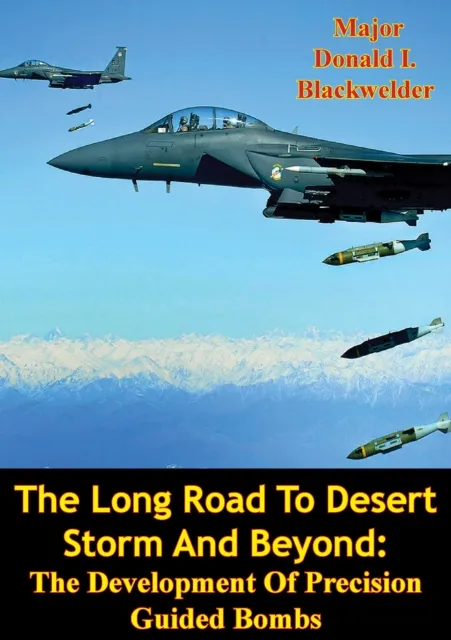
Long Road To Desert Storm And Beyond: The Development Of Precision Guided Bombs

Introduction
This paper examines the long development of precision guided bombs to show that the accuracy attained in Desert Storm was an evolution not a revolution in aerial warfare. This evolution continues and gives offensive airpower the advantage over the defense.
Early Development
Guided bomb development started during World War One with the aerial torpedo. During World War Two the German Fritz X and Hs-293 were visually guided bombs and both experienced success against allied shipping. The Army Air Corps also developed a wide variety of TV, heat, radar, and visually guided bombs. The visually guided AZON was successful in Burma and the radar guided Bat was successful against Japanese ships.
Mid-20th Century Advances
During the Korean War visually guided RAZON and TARZON bombs had some success. In Vietnam the Paveway I laser-guided bombs and Walleye TV-guided bombs were successful on a much broader scale. Paveway II and III, Walleye II, and GBU-15s were developed and successfully combat tested throughout the 1970s and 1980s.
Desert Storm and Modern Developments
When Desert Storm initiated in 1991 there were very few guided weapons that had not been extensively tested on training ranges and in combat. The precision demonstrated to the World during Desert Storm started evolving when airpower was first envisioned as a new dimension for conducting war, and was far from a revolution. Now, the continued development of imaging infrared, laser radar, synthetic aperture radar, and millimeter wave radar autonomous seekers further increases the flexibility, range, and effectiveness of guided bombs.