£29.99
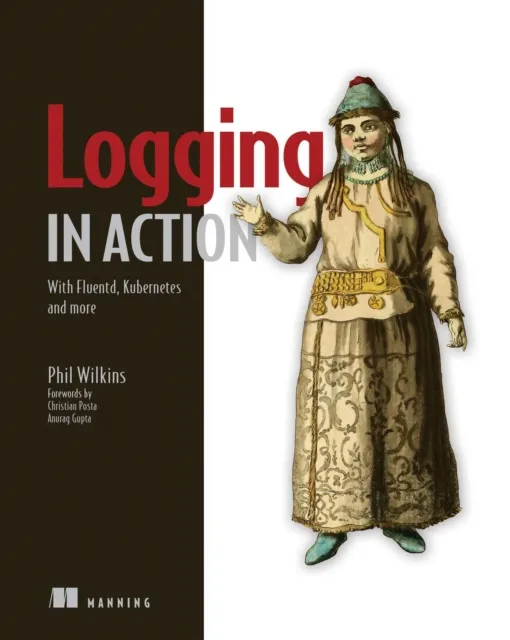
Logging in Action
With Fluentd, Kubernetes and more

Make log processing a real asset to your organization with powerful and free open source tools.
In Logging in Action you will learn how to:
Deploy Fluentd and Fluent Bit into traditional on-premises, IoT, hybrid, cloud, and multi-cloud environments, both small and hyperscaled
Configure Fluentd and Fluent Bit to solve common log management problems
Use Fluentd within Kubernetes and Docker services
Connect a custom log source or destination with Fluentd’s extensible plugin framework
Logging best practices and common pitfalls
Logging in Action is a guide to optimize and organize logging using the CNCF Fluentd and Fluent Bit projects. You’ll use the powerful log management tool Fluentd to solve common log management, and learn how proper log management can improve performance and make management of software and infrastructure solutions easier. Through useful examples like sending log-driven events to Slack, you’ll get hands-on experience applying structure to your unstructured data.
About the technology
Don’t fly blind! An effective logging system can help you see and correct problems before they cripple your software. With the Fluentd log management tool, it’s a snap to monitor the behavior and health of your software and infrastructure in real time. Designed to collect and process log data from multiple sources using the industry-standard JSON format, Fluentd delivers a truly unified logging layer across all your systems.
About the book
Logging in Action teaches you to record and analyze application and infrastructure data using Fluentd. Using clear, relevant examples, it shows you exactly how to transform raw system data into a unified stream of actionable information. You’ll discover how logging configuration impacts the way your system functions and set up Fluentd to handle data from legacy IT environments, local data centers, and massive Kubernetes-driven distributed systems. You’ll even learn how to implement complex log parsing with RegEx and output events to MongoDB and Slack.
What’s inside
Capture log events from a wide range of systems and software, including Kubernetes and Docker
Connect to custom log sources and destinations
Employ Fluentd’s extensible plugin framework
Create a custom plugin for niche problems
About the reader
For developers, architects, and operations professionals familiar with the basics of monitoring and logging.
About the author
Phil Wilkins has spent over 30 years in the software industry. Has worked for small startups through to international brands.
Table of Contents
PART 1 FROM ZERO TO “HELLO WORLD”
1 Introduction to Fluentd
2 Concepts, architecture, and deployment of Fluentd
PART 2 FLUENTD IN DEPTH
3 Using Fluentd to capture log events
4 Using Fluentd to output log events
5 Routing log events
6 Filtering and extrapolation
PART 3 BEYOND THE BASICS
7 Performance and scaling
8 Driving logs with Docker and Kubernetes
9 Creating custom plugins
PART 4 GOOD LOGGING PRACTICES AND FRAMEWORKS TO MAXIMIZE LOG VALUE
10 Logging best practices
11 Logging frameworks