£28.99
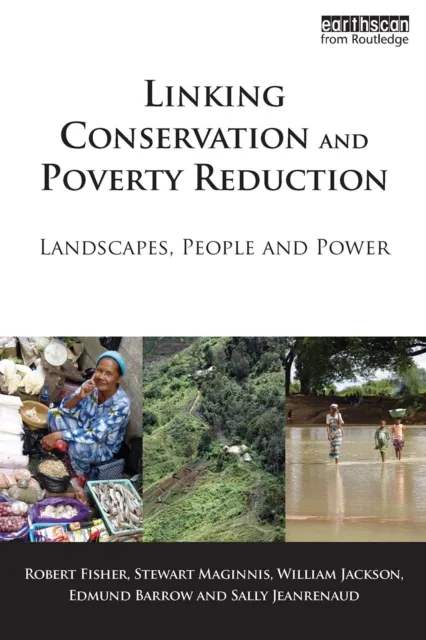
Linking Conservation and Poverty Reduction
Landscapes, People and Power

Praise for the first edition
''This book aims to inspire the conservation community not to regard poverty reduction as someone else''s job but to take responsibility for it as part of ecosystem restoration. Though no solutions are perfect, the text and examples given offer encouraging and useful guidance.'' Gill Shepherd, poverty and landscapes thematic leader, IUCN Forest Conservation Programme. ''This book could be the catalyst for a real paradigm shift - not just in capital cities and international conference centres, but also on the ground in locations where poor people are struggling to make a living.'' Policy Matters
Introduction
High levels of rural poverty in many of the world's ecosystems make it an ethical and practical imperative to find more equitable and realistic ways of achieving conservation. Livelihoods of the rural poor and options for conservation and sustainable use of biological diversity are so intimately entwined that they are better addressed through an integrated approach, irrespective of whether the primary motivation is one of development or one of conservation.
This highly accessible book, a revised edition of the 2005 book Poverty and Conservation: Landscapes, People and Power, offers a grand overview of the issues and a conceptual framework for addressing poverty reduction in the context of conservation, and conservation in the context of poverty reduction. It will appeal to professionals working in the field as well as to students across the fields of conservation, development and sustainability.
It looks at the rationale for addressing the links between conservation and poverty reduction, arguing that such a focus is both ethically essential and a source of opportunities. It also reviews experiences in dealing with people and conservation and identifies some key lessons and concepts.
The book presents case studies illustrating various approaches and a discussion of some of the issues that appear when implementing combined conservation and poverty reduction. The book emphasizes the importance of multiple spatial scales and negotiating trade-offs between scales. It also tackles the complex issue of institutional landscapes and the way in which changes at various institutional levels can lead to different and often more positive outcomes.
The final part summarizes some of the main features of the authors' integrated approach and identifies some of the challenges involved in efforts to combine conservation and poverty reduction. Published with IUCN - The World Conservation Union.