£52.99
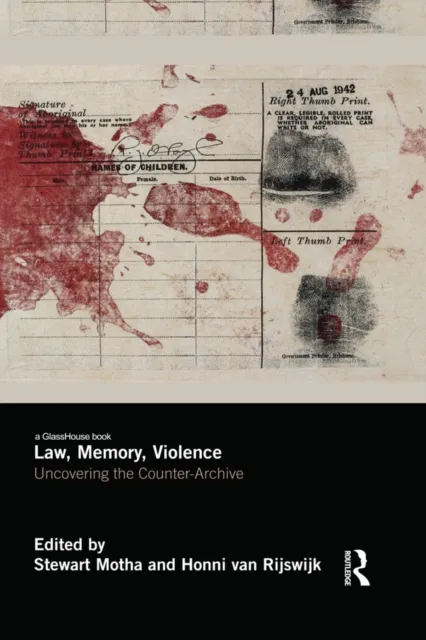
Law, Memory, Violence
Uncovering the Counter-Archive

Introduction
The demand for recognition, responsibility, and reparations is regularly invoked in the wake of colonialism, genocide, and mass violence: there can be no victims without recognition, no perpetrators without responsibility, and no justice without reparations. Or so it seems from law’s limited repertoire for assembling the archive after ‘the disaster’. Archival and memorial practices are central to contexts where transitional justice, addressing historical wrongs, or reparations are at stake. The archive serves as a repository or ‘storehouse’ of what needs to be gathered and recognised so that it can be left behind in order to inaugurate the future. The archive manifests law’s authority and its troubled conscience. It is an indispensable part of the liberal legal response to biopolitical violence.
Challenging Established Approaches
This collection challenges established approaches to transitional justice by opening up new dialogues about the problem of assembling law’s archive. The volume presents research drawn from multiple jurisdictions that address the following questions. What resists being archived? What spaces and practices of memory - conscious and unconscious - undo legal and sovereign alibis and confessions? And what narrative forms expose the limits of responsibility, recognition, and reparations? By treating the law as an ‘archive’, this book traces the failure of universalised categories such as perpetrator, victim, responsibility, and innocence, posited by the liberal legal state. It thereby uncovers law’s counter-archive as a challenge to established forms of representing and responding to violence.