£48.99
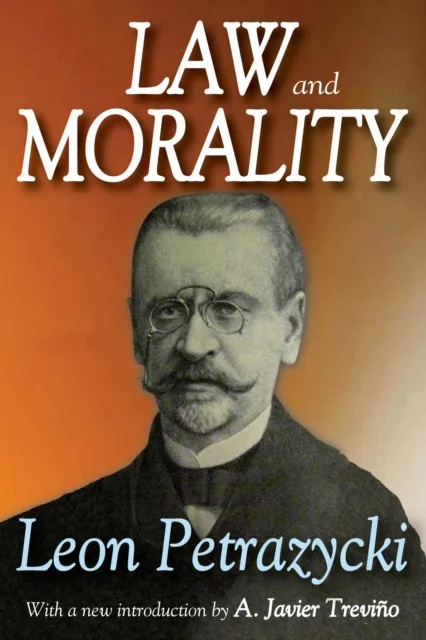
Law and Morality

Analysis of Petrazycki's Legal Theory
In analyzing the socio-psychic nature and operations of intuitive legal rules, Petrazycki formulates a theory of law around five conceptual themes: anti-formalism, imperative-attributive legal relationships, law's functional control, law's subjective reality, and morality.
Petrazycki presents the two ways by which law coordinates and regulates social conduct as through its distributive and organizing functions.
Objective of Law and Morality
Law and Morality has a basic objective: to analyze interrelations between positive and intuitive law.
Petrazycki's socio-psychic orientation toward law is behavioral as well as thoughtful. He finds the most suitable methods for obtaining knowledge about legal experiences to be internal and external observation.
His technique of introspection is similar to Max Weber's conceptual method.
Interpretive Understanding
Petrazycki distinguishes between two kinds of interpretive understanding. External observation involves deriving the meaning of an act or symbolic expression from immediate observation without reference to any broader context, and internal observation involves placing the particular act in a broader context of meaning involving facts that cannot be derived from a particular act or expression.
Relevance and Impact
Petrazycki's socio-legal ideas remain relevant in today's society. His arguments concerning the global expansion of human love have an attraction for those working towards a better world.
In the context of positive psychology and the growing happiness industry, Petrazycki's ideas will compel legal scholars to consider his arguments.
Petrazycki's work stands out for the scientific ambitions and systematic nature of his thought as well as the influence of his work on later scholars in the sociology of law.