£139.50
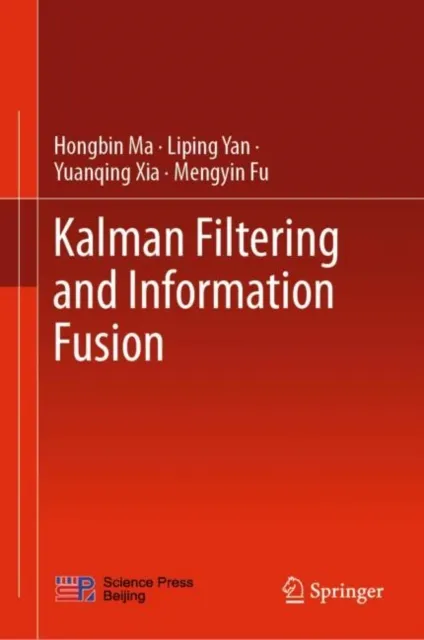
Kalman Filtering and Information Fusion

Introduction to Kalman Filtering
This book addresses a key technology for digital information processing: Kalman filtering, which is generally considered to be one of the greatest discoveries of the 20th century. It introduces readers to issues concerning various uncertainties in a single plant, and to corresponding solutions based on adaptive estimation. Further, it discusses in detail the issues that arise when Kalman filtering technology is applied in multi-sensor systems and/or multi-agent systems, especially when various sensors are used in systems like intelligent robots, autonomous cars, smart homes, smart buildings, etc., requiring multi-sensor information fusion techniques. Furthermore, when multiple agents (subsystems) interact with one another, it produces coupling uncertainties, a challenging issue that is addressed here with the aid of novel decentralized adaptive filtering techniques.
Book's Goals and Audience
Overall, the book’s goal is to provide readers with a comprehensive investigation into the challenging problem of making Kalman filtering work well in the presence of various uncertainties and/or for multiple sensors/components. State-of-art techniques are introduced, together with a wealth of novel findings. As such, it can be a good reference book for researchers whose work involves filtering and applications; yet it can also serve as a postgraduate textbook for students in mathematics, engineering, automation, and related fields.
Prerequisites
To read this book, only a basic grasp of linear algebra and probability theory is needed, though experience with least squares, navigation, robotics, etc. would definitely be a plus.