£74.50
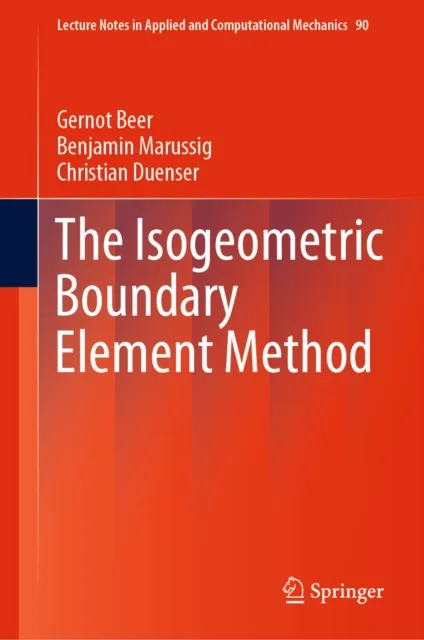
Isogeometric Boundary Element Method

Introduction to Isogeometric Technology in Boundary Element Method
This book discusses the introduction of isogeometric technology to the boundary element method (BEM) in order to establish an improved link between simulation and computer aided design (CAD) that does not require mesh generation.
In the isogeometric BEM, non-uniform rational B-splines replace the Lagrange polynomials used in conventional BEM. This may seem a trivial exercise, but if implemented rigorously, it has profound implications for the programming, resulting in software that is extremely user friendly and efficient.
Advantages and Implementation
The BEM is ideally suited for linking with CAD, as both rely on the definition of objects by boundary representation. The book shows how the isogeometric philosophy can be implemented and how its benefits can be maximised with a minimum of user effort.
Examples and Results
Using several examples, ranging from potential problems to elasticity, it demonstrates that the isogeometric approach results in a drastic reduction in the number of unknowns and an increase in the quality of the results. In some cases even exact solutions without refinement are possible.
Practical Applications and Advanced Topics
The book also presents a number of practical applications, demonstrating that the development is not only of academic interest. It then elegantly addresses heterogeneous and non-linear problems using isogeometric concepts, and tests them on several examples, including a severely non-linear problem in viscous flow.
Conclusion
The book makes a significant contribution towards a seamless integration of CAD and simulation, which eliminates the need for tedious mesh generation and provides high-quality results with minimum user intervention and computing.