£64.99
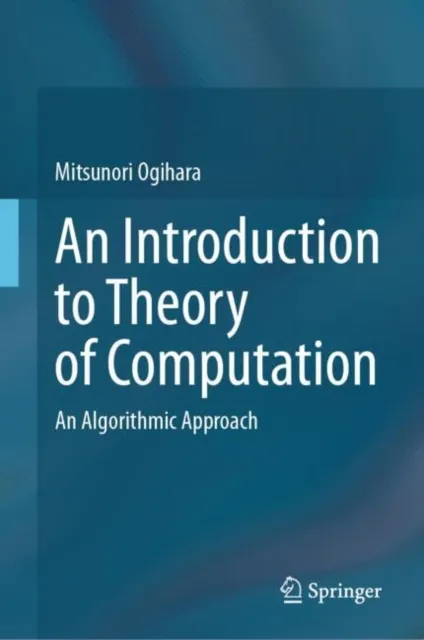
Introduction to Theory of Computation
An Algorithmic Approach

Introduction
This textbook aims to provide a comprehensive introduction to the theory of computation for upper-level undergraduate students and first-year graduate students in computer science and related disciplines. It covers a wide range of foundational topics essential for understanding the principles and applications of computation.
Regular Languages
The book begins with regular languages, exploring finite automata, nondeterministic finite automata, regular expressions, and the equivalence among these apparatuses. It explores state minimization and the Myhill-Nerode Theorem, offering techniques such as pumping lemmas to identify non-regular languages and using the Myhill-Nerode Theorem for non-regularity proofs. Additionally, the closure properties of regular languages are examined.
Context-Free Languages
Context-free languages are another focal point, where the text discusses context-free grammars, Chomsky normal form grammars, pushdown automata, and their equivalences. The book includes pumping lemmas and closure properties using CNF grammars and PDA analysis, as well as identifying non-context-free languages and understanding leftmost derivations.
Turing Machines
Turing machine models are thoroughly covered, with various models and simulations explained. The book outlines configurations, the Church-Turing Thesis, and differentiates between recursive and recursively enumerable languages.
Decidability and Undecidability
Decidability and undecidability are critical topics in the text, addressing decidable problems, diagonalization, the halting problem, and Rice’s Theorem. It also provides a characterization of decidability, discusses the Post Correspondence Problem, and examines the lower levels of the arithmetical hierarchy.
Computational Complexity Classes
The textbook also delves into computational complexity classes, defining time and space complexity classes, and presenting efficient simulations and hierarchy theorems, including the Hennie-Stearns Theorem. It includes examples of problems in P and NP, providing a clear understanding of these classifications.
NP-Completeness
NP-completeness is explored in detail, covering SAT and 3SAT, canonical complete problems, and various NP-complete problems. The book extends to space complexity classes, discussing PSPACE complete problems, NL-complete problems, and proving that NL=coNL.
Beyond NP-Completeness
Finally, the text ventures beyond NP-completeness, discussing Ladner’s construction of non-NPC sets, randomized complexity classes, and concepts such as BPP and the polynomial hierarchy. It also examines polynomial size circuits, providing a comprehensive view of the landscape of computational complexity.